Fermented foods: assessing histamine levels for gut health
Fermented foods can support dietary diversity, but fermentation is not chemically neutral. Microorganisms may convert the amino acid L-histidine into histamine through the enzyme histidine decarboxylase, or HDC.
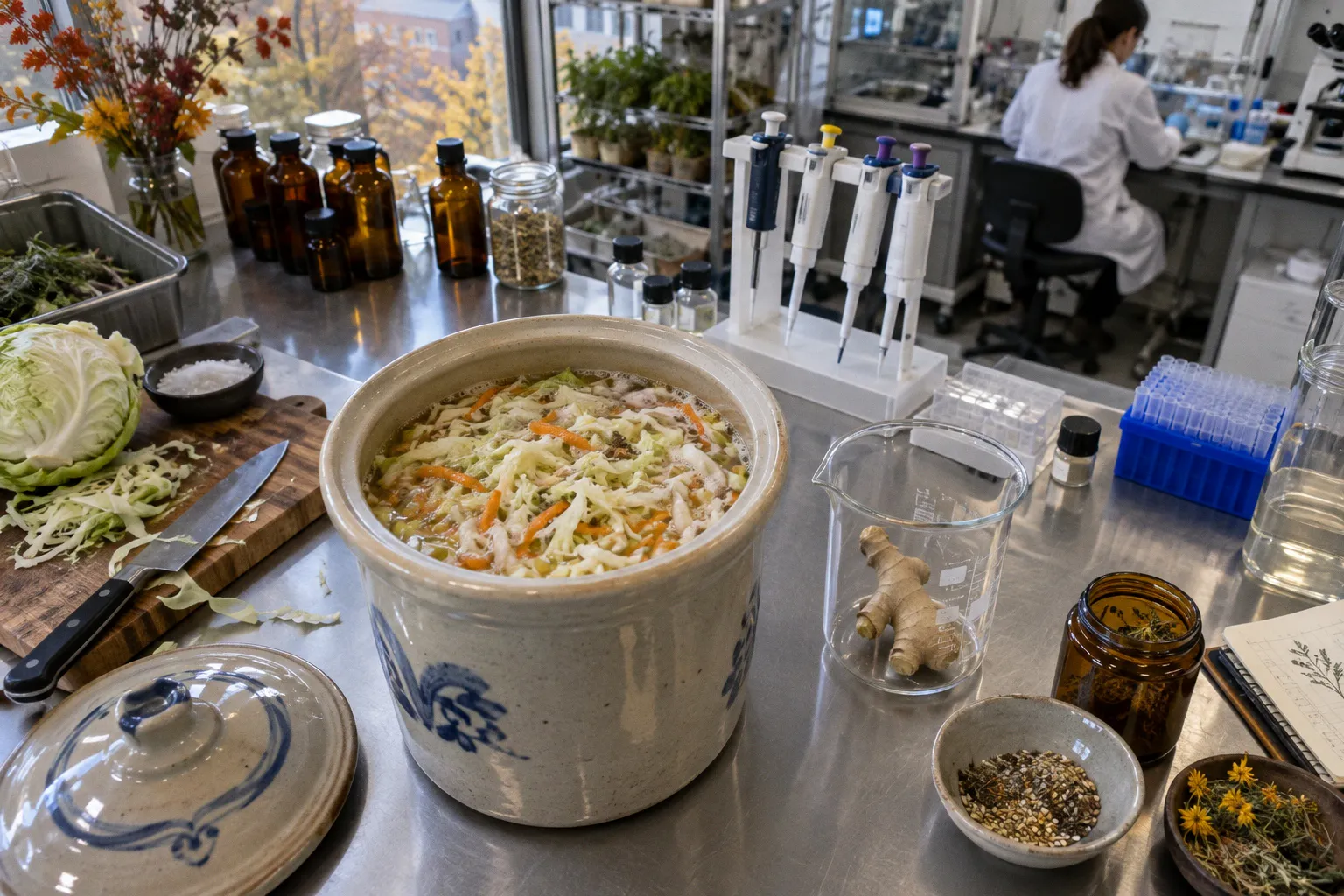
The result is a variable histamine load that depends on the food matrix, microbial strain, temperature, acidity, salt concentration, and aging period.
For most people, this is not clinically significant. Histamine is degraded in the intestinal lumen, primarily by diamine oxidase, or DAO. However, an estimated 1–3% of the population may have impaired histamine degradation associated with reduced DAO activity. In that group, fermented foods can produce gastrointestinal and systemic symptoms despite being conventionally classified as probiotic or beneficial.
The practical problem is not whether fermented foods are inherently healthy or harmful. The relevant question is whether the specific food, fermentation process, and individual degradation capacity are compatible.
The biochemistry of fermentation: from histidine to histamine
Fermentation involves microbial metabolism. Bacteria consume available substrates and produce organic acids, gases, alcohols, enzymes, and other metabolites. Some microorganisms also express HDC. This enzyme catalyzes the decarboxylation of L-histidine:
L-histidine → histamine + carbon dioxide
Certain Lactobacillus and Enterococcus species are capable of producing HDC. Their presence does not automatically mean that a food will contain clinically relevant histamine. The enzyme activity depends on the strain and on the fermentation environment.
This distinction matters. “Lactobacillus” is not a single metabolic entity. Different strains within the same broad genus can have different effects on histamine production. A food fermented with one strain may have a very different histamine profile from a similar food fermented with another strain.
Histamine accumulation is also dependent on substrate availability. If the raw ingredient contains more free histidine, the microbial pathway has more material to convert. Protein-rich foods may therefore behave differently from vegetable ferments. The final concentration still cannot be predicted from the ingredient category alone.
Acidity is another variable. As fermentation progresses, pH generally falls because microorganisms produce acids. This may suppress some competing organisms, but it does not provide a universal histamine-control mechanism. Certain histamine-producing strains remain active under acidic conditions. The relationship between low pH and histamine content is therefore not linear.
Salt concentration, oxygen exposure, temperature, and fermentation duration all alter microbial selection. A longer fermentation period may increase histamine accumulation if HDC-producing organisms remain active and sufficient histidine is available. It may have a different outcome in a controlled process with a defined starter culture.
A finished label such as “naturally fermented” does not resolve these variables. It describes a production category, not the histamine concentration of the final batch.
Fermentation can increase microbial diversity in the diet while simultaneously increasing histamine exposure. These are separate biological outcomes.
DAO deficiency and histamine intolerance
DAO is the principal enzyme responsible for degrading ingested histamine in the intestinal lumen. When DAO activity is sufficient, dietary histamine is metabolized before it produces a substantial systemic effect. When DAO activity is impaired, a larger fraction may remain available for absorption.
Histamine intolerance is therefore primarily a degradation problem. It is not equivalent to an IgE-mediated food allergy. The immune mechanisms, diagnostic logic, and clinical management are different.
DAO activity can be influenced by several factors, including intestinal mucosal integrity, inherited variation, gastrointestinal disease, and exposure to certain medications. The available evidence does not support a single universal biomarker cutoff that reliably confirms histamine intolerance in every patient. Symptoms and laboratory findings also do not always correlate with a fixed food concentration.
Reported histamine intolerance symptoms may include:
- Abdominal pain, bloating, loose stools, or urgency after high-histamine meals.
- Nausea or upper gastrointestinal discomfort.
- Flushing, headache, nasal symptoms, or palpitations.
- A sensation of reflux or meal-related chest discomfort.
- Variable reactions to foods that are tolerated at other times.
These symptoms are non-specific. Irritable bowel syndrome, reflux disease, food allergy, mast-cell disorders, carbohydrate malabsorption, and medication effects can produce overlapping patterns. A symptom after sauerkraut or aged cheese does not establish DAO deficiency.
The timing of symptoms is clinically useful but not diagnostic by itself. Histamine reactions may occur relatively soon after exposure, while fermentation-related gastrointestinal symptoms can also develop through osmotic effects, gas production, FODMAP content, meal size, or food contamination. The entire meal must be considered.
A strict elimination diet can reduce exposure, but indiscriminate restriction introduces a different risk: lower fiber diversity, reduced intake of polyphenols, inadequate protein or calcium, and greater dependence on a narrow set of foods. The objective of a low-histamine diet for gut healing should be controlled reduction of a suspected trigger, not permanent exclusion without reassessment.
Why fermented foods vary so widely in histamine content
Histamine concentration is not a stable property of a food name. It is a process outcome. Two batches of the same product can differ substantially because their microbial communities and production conditions differ.
The principal variables are:
Microbial strain
The most important distinction is not simply whether a food contains bacteria. It is whether those bacteria possess HDC activity. Starter cultures selected for predictable acid production may behave differently from uncontrolled environmental fermentation.
Strain identification is often incomplete on consumer packaging. A label may list a genus and species without identifying the strain or its capacity for histamine production. This limits the ability to predict histamine content from the label alone.
Fermentation duration
Time allows microbial metabolism to continue. Histamine may accumulate during extended fermentation, especially when HDC-producing organisms remain active. The relationship is not a fixed equation. Some batches may show little change, while others develop higher levels as aging progresses.
This is particularly relevant to aged cheeses and cured or fermented protein-rich foods. Hard aged cheeses such as Parmesan have been observed with histamine concentrations exceeding 2,000 mg/kg. That value cannot be generalized to every Parmesan product, but it demonstrates the scale of possible accumulation.
Temperature
Temperature selects for different microbial populations and changes enzymatic activity. A fermentation process held at one temperature may produce a different metabolite profile from the same recipe held at another. Temperature abuse during storage can also permit further microbial activity after production.
Cold storage may slow ongoing metabolism. It does not reliably remove histamine that has already accumulated. Histamine is not simply neutralized by refrigeration.
pH and salt
Acidification and salting shape the microbial ecosystem. They can suppress some organisms and favor others. Neither low pH nor high salt guarantees a low-histamine product.
Salt concentration is especially relevant in vegetable ferments. A salt level that changes microbial succession can alter both acid production and the persistence of organisms capable of histamine formation. The effect depends on the complete production protocol.
Raw material and free histidine
Histamine is produced from histidine. The quantity and accessibility of histidine in the raw material therefore influence the potential for accumulation. Protein composition, tissue breakdown, and proteolysis can change the amount of free amino acid available to microorganisms.
This is one reason fermented dairy, fish, meat, and vegetable products should not be treated as interchangeable categories. Their substrates differ. Their microbial ecology differs. Their histamine risk profile differs.
Storage after fermentation
Histamine accumulation is not limited to the primary fermentation stage. Continued aging, temperature fluctuations, and poor handling may alter the final concentration. A product that was acceptable when fresh may become less predictable after prolonged storage.
For histamine-sensitive individuals, the interval between opening and consumption may also matter. The exact effect is product-specific and cannot be assigned a universal number of days.
| Variable | Effect on histamine formation | Practical interpretation |
|---|---|---|
| Microbial strain | Determines whether HDC is produced and how actively it functions | Species-level labeling may be insufficient |
| Fermentation time | Provides more time for microbial histamine production | Longer aging is not automatically lower risk |
| Temperature | Alters microbial growth and enzyme activity | Process control affects batch consistency |
| pH | Selects for acid-tolerant organisms | Acidity alone does not guarantee low histamine |
| Salt concentration | Changes microbial succession | Salted ferments remain variable |
| Raw material | Determines available histidine and protein structure | Fermented foods cannot be assessed as one category |
| Storage duration | May permit continued microbial activity | Refrigeration slows change but does not erase histamine |
Assessing histamine levels in probiotic foods
The phrase “probiotic food” describes a potential biological function, not a histamine specification. A fermented product can contain viable microorganisms and still be unsuitable for a person with reduced histamine degradation.
This is where the current consumer market has a measurement problem. Histamine content is often not displayed on food labels. Even when a product is manufactured under controlled conditions, a single published value may not represent every production batch.
Some dietary frameworks describe low-histamine foods using thresholds below 1 mg/kg or below 20 mg/kg. These are not universal diagnostic standards. They are classification thresholds used in particular dietary approaches. They should not be mistaken for a globally validated cutoff for symptom onset.
Regulatory limits for histamine poisoning provide a different reference point. For fish, action levels may be set at 50 parts per million, while some safety frameworks reference values up to 200 mg/kg for certain food products. These thresholds address acute histamine poisoning, including scombroid poisoning. They are not designed to diagnose or manage chronic individual sensitivity.
This distinction is essential:
- Food-safety thresholds are intended to identify potentially hazardous contamination or poisoning.
- Low-histamine diet thresholds are used to reduce exposure in sensitive individuals.
- Clinical tolerance varies according to DAO activity, meal composition, dose, and other physiological variables.
A person with histamine intolerance may react below a regulatory threshold. Conversely, another person may tolerate a food that exceeds a dietary classification threshold without symptoms. Regulatory safety and personal tolerance are not interchangeable endpoints.
A practical protocol for histamine-sensitive gut symptoms
A naturopathic approach should remain observational and reversible. It should not convert every digestive symptom into a permanent dietary restriction.
1. Establish the symptom pattern
Record the food, portion, preparation method, storage interval, accompanying foods, and time to symptom onset. The useful unit is not merely “fermented foods.” It is the specific product and exposure context.
For example, a reaction may be associated with aged cheese rather than all dairy, with long-stored leftovers rather than freshly cooked protein, or with a large serving of fermented vegetables rather than a small amount.
2. Remove the most plausible high-histamine exposures
A short, structured reduction can focus on foods with a greater potential for accumulation: aged cheeses, certain cured products, long-fermented foods, and foods with uncertain storage history. The purpose is to test whether symptom burden changes.
The protocol should preserve nutritional adequacy. Freshly prepared foods, a broad selection of tolerated plant foods, sufficient protein, and appropriate fiber should remain in the diet where clinically tolerated.
3. Avoid changing every dietary variable at once
Simultaneously removing gluten, dairy, legumes, nightshades, grains, sugar, and fermented foods makes interpretation impossible. It also reduces microbiome substrate diversity. A controlled protocol changes fewer variables and produces more usable information.
4. Reintroduce one variable at a time
If symptoms improve, individual foods can be reintroduced in measured portions. The response should be recorded over the relevant observation period. A single adverse response does not prove that all foods in the same category are problematic.
Tolerance may be dose-dependent. A small serving may be tolerated while a larger serving is not. Meal composition may also modify the response. This does not justify inventing a universal safe dose; it supports individualized titration under appropriate clinical supervision.
5. Investigate competing explanations
Persistent symptoms require a broader assessment. Histamine intolerance should not become a default explanation for reflux, diarrhea, bloating, or flushing. Differential considerations include IBS, inflammatory gastrointestinal disease, food allergy, mast-cell activation disorders, enzyme deficiencies, and medication-related effects.
DAO testing and clinical interpretation remain imperfect. No single test should replace symptom analysis and evaluation of other causes.
A low-histamine protocol is most useful as a controlled experiment. It is least useful when it becomes an unmeasured, indefinite restriction.
Measuring histamine in food: what laboratory analysis can and cannot show
Food histamine can be measured by several laboratory techniques:
- High-Performance Liquid Chromatography, or HPLC.
- Enzyme-Linked Immunosorbent Assay, or ELISA.
- UV-visible spectrophotometry.
HPLC is commonly used when analytical separation and quantification are required. ELISA can be practical for screening but depends on assay design and validation. UV-visible methods may be less specific because other compounds can influence absorbance.
The analytical method is only one part of the result. Sampling is equally important. Fermented foods are heterogeneous. Histamine may not be distributed uniformly throughout a batch, particularly in solid foods or products with variable microbial growth. A single sample may not represent the entire container or production run.
Laboratory findings should therefore include, where available:
- The exact product and batch.
- Sampling location and preparation.
- The analytical method.
- The method’s detection and quantification limits.
- Quality-control procedures.
- Whether the result is reported as mg/kg or another unit.
A numerical result without this context can create false precision. The same applies to online food lists that assign one histamine value to an entire category. Histamine concentrations vary too widely for many such tables to function as definitive clinical tools.
There is also a unit-conversion issue. One milligram per kilogram is equivalent to one part per million in a food matrix, but dietary guidance may use different thresholds and terminology. The unit must be read before comparing a laboratory result with a dietary framework or regulatory value.
What fermented-food selection looks like in practice
The objective is not to remove all fermented foods from a gut-health strategy. Fermented foods may provide organic acids, microbial metabolites, and dietary variety. The objective is to select products and portions that match the individual’s tolerance and the level of process control available.
Several principles are more defensible than universal food bans:
- Prefer products with clear manufacturing information and controlled storage.
- Treat long-aged, cured, or heavily fermented foods as more variable than freshly prepared foods.
- Be cautious with products that have an unknown fermentation history or prolonged storage.
- Introduce one fermented food at a time when assessing sensitivity.
- Use portion size as an experimental variable rather than assuming binary tolerance.
- Do not infer histamine content from the word “probiotic.”
- Do not use regulatory poisoning thresholds as personal tolerance targets.
- Preserve fiber diversity unless a specific food repeatedly produces symptoms.
- Reassess the protocol rather than maintaining indefinite restriction by default.
For individuals without symptoms associated with fermented foods, routine avoidance is not supported by the available facts. Healthy people generally metabolize dietary histamine efficiently through DAO. The existence of histamine formation during fermentation does not make fermented foods universally unsafe.
The relevant clinical distinction is between fermentation as a food-production process and histamine exposure as a dose-dependent metabolic variable. They overlap, but they are not identical.
Final assessment
Fermented foods and histamine require a process-based assessment. HDC-producing microorganisms can convert histidine into histamine. DAO normally degrades ingested histamine in the intestinal lumen. Reduced DAO activity may increase susceptibility, but symptoms alone do not establish a diagnosis and no single global cutoff defines individual intolerance.
Histamine content varies with microbial strain, raw material, pH, salt, temperature, fermentation time, and storage. Aged products can reach high concentrations; Parmesan has been observed above 2,000 mg/kg. By contrast, low-histamine dietary frameworks may use thresholds below 1 mg/kg or 20 mg/kg, while food-safety action levels address a different problem and may reach 50 ppm or 200 mg/kg depending on the product and regulatory framework.
The most reliable protocol is narrow, measured, and reversible:
- Track the exact food, portion, storage history, and symptom timing.
- Reduce the most plausible high-histamine exposures for a defined period.
- Maintain nutritional and fiber diversity.
- Reintroduce foods individually.
- Investigate alternative explanations for persistent symptoms.
- Interpret laboratory histamine results in relation to method, batch, and units.
Fermentation can remain part of a gut-health diet. It should not be treated as automatically therapeutic, and it should not be treated as automatically pathological. The decisive variables are histamine production, intestinal degradation capacity, exposure dose, and individual clinical response.