Tart cherry juice vs glycine: sleep onset mechanisms compared
Difficulty falling asleep does not always reflect a shortage of melatonin. Sleep onset depends on several systems moving into alignment: circadian timing, body temperature, tryptophan availability…
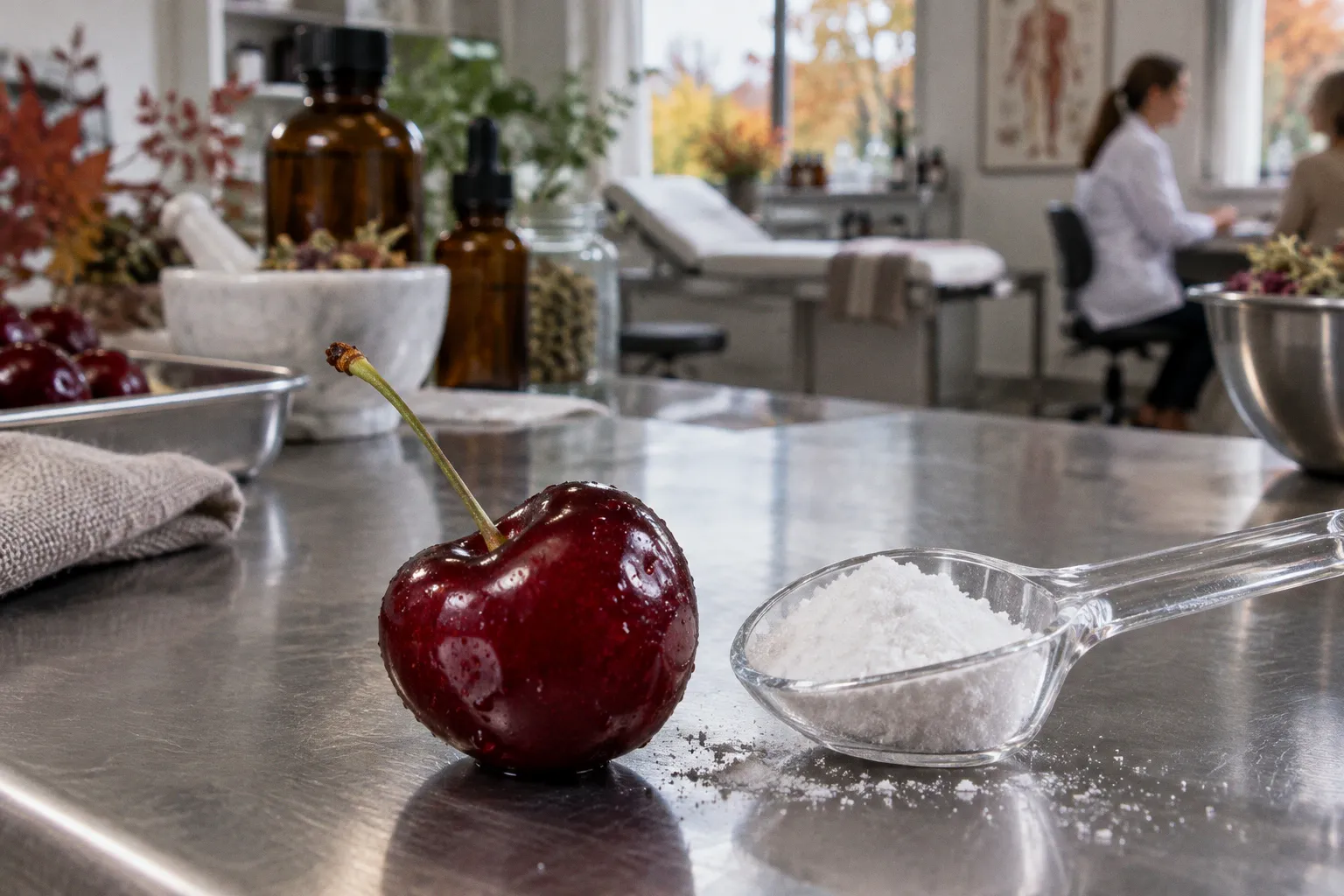
Difficulty falling asleep does not always reflect a shortage of melatonin. Sleep onset depends on several systems moving into alignment: circadian timing, body temperature, tryptophan availability, nervous-system signaling, and the transition from daytime alertness to nighttime recovery.
That is why tart cherry juice and glycine are useful to compare. Both are discussed as natural sleep aids, but they do not work through the same pathway. Tart cherry juice supplies plant compounds associated with melatonin production and tryptophan preservation. Glycine acts more directly on the body’s thermoregulatory system, helping lower core temperature at the time sleep begins.
For anyone weighing tart cherry juice vs glycine for sleep onset, the practical distinction is straightforward: tart cherry juice supports the biochemical ingredients and timing signals involved in sleep, while glycine helps the body carry out one of the physical transitions that makes sleep initiation easier.
Tart cherry juice and the melatonin connection
Tart cherries contain natural plant melatonin as well as tryptophan, an amino acid used as a precursor for serotonin and melatonin synthesis. The amount of tryptophan is approximately 9 mg per 100 grams of tart cherries.
That figure needs context. Tart cherry juice is not a liquid version of a high-dose melatonin tablet. Its melatonin content is considerably lower than the amount found in standard over-the-counter melatonin supplements. Its potential value comes from a broader combination of compounds rather than from delivering a pharmaceutical-level dose of one hormone.
The pathway can be viewed as a supply chain. Tryptophan is one of the raw materials involved in the production of serotonin and melatonin. If the body has access to that material and the surrounding system is ready for nighttime signaling, it can support the normal sequence that helps the brain and body move toward sleep.
Tart cherry juice also contains procyanidin B-2. This compound inhibits indoleamine 2,3-dioxygenase, or IDO, an enzyme that breaks down tryptophan. In practical terms, reducing this breakdown may preserve more tryptophan for pathways associated with serotonin and melatonin synthesis.
This is different from saying that tart cherry juice forces the body to produce a large amount of melatonin. The mechanism is more measured. The juice provides a small amount of plant melatonin, supplies tryptophan, and may help preserve that tryptophan by influencing IDO activity. It also has been associated with lower inflammatory markers such as PGE2 in the research summarized for this comparison.
Tart cherry juice works more like a supportive supply system for nighttime chemistry than like a high-dose melatonin pill.
The sleep benefits observed in clinical research should also be interpreted with care. In a trial involving older adults with chronic insomnia, drinking 240 mL of tart cherry juice twice daily increased sleep time by 84 minutes on polysomnography and improved sleep efficiency. That is a meaningful result, but it came from a specific population and protocol. It does not establish that the same response will occur for every person with occasional difficulty falling asleep.
Glycine and the body-temperature shift that supports sleep
Glycine takes a different route. It is an amino acid and a neurotransmitter with effects that are relevant to sleep physiology. Before bedtime, glycine acts as a co-agonist at NMDA receptors in the suprachiasmatic nucleus, or SCN.
The SCN is a central component of the body’s circadian timing system. It helps coordinate daily rhythms, including the timing signals that distinguish biological day from biological night. Glycine’s role in this setting is not primarily sedative. It does not function like a conventional sleeping drug that suppresses wakefulness.
Instead, glycine supports sleep onset through thermoregulation. It promotes cutaneous vasodilation, increasing blood flow toward the skin and helping lower core body temperature. That cooling process is part of the body’s normal preparation for sleep.
The body can be compared with a building that changes operating mode overnight. During the day, systems prioritize alertness, movement, and active temperature regulation. As sleep approaches, the building begins releasing heat through its outer surfaces, lowering the internal temperature set point. Glycine appears to support that changeover rather than simply switching consciousness off.
Clinical studies have found that consuming 3 grams of glycine before bedtime can shorten polysomnographic sleep-onset latency and reduce morning fatigue without causing residual daytime drowsiness. Peak serum glycine concentrations are reached approximately 30 to 60 minutes after oral ingestion, which fits the physiological window in which the body begins preparing for sleep.
This timing is one of glycine’s clearest practical features. If the main difficulty is lying awake while the body still feels warm, activated, or unable to settle, the thermoregulatory pathway may be more relevant than adding another source of melatonin-related compounds.
Tart cherry juice vs glycine for sleep onset
The two approaches overlap in their goal but differ in their primary mechanism.
| Parameter | Tart cherry juice | Glycine |
|---|---|---|
| Main sleep-related pathway | Supplies plant melatonin and tryptophan; may preserve tryptophan by inhibiting IDO | Supports thermoregulation through NMDA receptor co-agonism in the SCN |
| Primary physiological effect | Supports the biochemical environment for melatonin synthesis and circadian nighttime signaling | Promotes peripheral vasodilation and a reduction in core body temperature |
| Relationship with melatonin | Contains natural plant melatonin and provides a precursor for endogenous melatonin production | Does not primarily work by supplying melatonin or acting as a melatonin substitute |
| Typical research protocol | 240 mL twice daily in a trial of older adults with chronic insomnia | 3 grams before bedtime |
| Timing detail | The twice-daily protocol provides repeated exposure rather than relying only on a bedtime dose | Serum glycine peaks approximately 30–60 minutes after ingestion |
| Most relevant sleep question | Is nighttime biochemical support limited by tryptophan availability or circadian signaling? | Is sleep onset delayed because the body is not cooling and transitioning efficiently? |
| Evidence limitation | The strongest result summarized here comes from a specific older-adult insomnia trial | The evidence supports shorter sleep-onset latency, but does not make glycine a universal insomnia treatment |
This comparison also explains why it is not accurate to frame the choice as melatonin versus glycine. Tart cherry juice contains melatonin and compounds related to melatonin production, while glycine supports a separate physiological route. One is not simply a weaker version of the other.
The distinction matters because sleep-onset problems are not uniform. Some people notice a mind that remains alert despite physical tiredness. Others become sleepy but cannot settle because they feel overheated, restless, or physically activated. A third group falls asleep without difficulty but wakes repeatedly. Tart cherry juice and glycine are most directly relevant to the first part of the sleep process: the transition into sleep.
Preserving tryptophan: why the cherry pathway is broader than melatonin
The phrase tart cherry juice melatonin content can create an overly narrow expectation. The juice’s value is not determined only by how much melatonin it contains at the moment you drink it.
Tryptophan is part of the larger picture. It contributes to the pathways that produce serotonin and melatonin, but it can also be diverted or degraded. IDO is one enzyme involved in tryptophan breakdown. Procyanidin B-2 may inhibit IDO, which potentially leaves more tryptophan available for other biological uses.
That mechanism links sleep with inflammation and nutritional psychiatry without reducing sleep to a single nutrient. When inflammatory signaling is elevated, tryptophan metabolism can shift. The result is not necessarily a simple deficiency, but a change in how available tryptophan is used. The procyanidin B-2 pathway is therefore relevant because it may help preserve the substrate needed for nighttime hormone synthesis.
This is also where precision matters. Tart cherry juice should not be presented as a guaranteed way to raise melatonin, correct inflammation, or resolve chronic insomnia. The evidence supports a plausible biological mechanism and specific clinical findings, not a universal promise.
The trial reporting an 84-minute increase in sleep time is encouraging, particularly because the measurement used polysomnography rather than relying only on subjective sleep diaries. Still, the participants were older adults with chronic insomnia, and the protocol used 240 mL twice daily. It would be a mistake to assume that a single glass at bedtime will reproduce the same outcome in a different population.
Glycine supplementation for sleep latency
Glycine is more targeted in relation to sleep timing. The commonly studied bedtime amount is 3 grams, and the serum concentration peak occurs within roughly 30 to 60 minutes. That gives the intervention a clear relationship with the period before sleep onset.
The relevant mechanism is cooling, not sedation. Glycine encourages blood flow to the skin through cutaneous vasodilation. As peripheral heat loss increases, core body temperature can fall. This is consistent with the body’s ordinary sleep-onset pattern.
For this reason, glycine may be especially interesting when you recognize a particular sequence:
1. You feel tired, but your body does not seem to shift into a lower-temperature state.
2. You remain physically warm or restless while trying to fall asleep.
3. You want to support sleep onset without a lingering sedative effect the next morning.
4. Your main concern is sleep latency rather than repeated nighttime awakening.
These observations do not diagnose a cause, and they should not be turned into a rigid rule. They simply help match the mechanism to the problem. Glycine supplementation for sleep latency is a more direct fit when the central issue is the physiological cooling window before sleep.
The research summarized here found shorter sleep-onset latency and less morning fatigue after 3 grams of glycine, without residual daytime drowsiness. That makes glycine distinct from substances that may produce a heavy or sedated feeling. However, a lack of daytime drowsiness in clinical studies does not mean every person will respond identically. Individual tolerance, timing, diet, medication use, and the underlying reason for poor sleep can all shape the experience.
Timing, dose, and the question of substitution
Tart cherry juice and glycine cannot be compared only by volume or convenience. Their protocols reflect different biological goals.
The tart cherry trial used 240 mL twice daily, equivalent to 16 ounces over the day. This is not the same as taking one small serving immediately before bed. The twice-daily schedule may provide sustained exposure to the compounds involved, although the available facts do not establish that a divided schedule is superior for every person.
Glycine was studied at 3 grams before bedtime. Its timing is easier to connect to a specific sleep-onset window because serum concentrations peak within 30 to 60 minutes.
A useful comparison looks like this:
- Tart cherry juice: a food-based intervention with plant melatonin, tryptophan, and procyanidin B-2. Its effects are connected to the raw materials and biochemical environment of nighttime hormone production.
- Glycine: an amino-acid intervention with a clearer thermoregulatory action. Its effects are connected to peripheral heat loss and core-temperature reduction.
- Melatonin supplement: not the same as either option. Tart cherry juice contains much smaller amounts of melatonin than standard supplement products, and glycine does not work primarily by supplying melatonin.
The absence of a direct head-to-head clinical trial is important. Current evidence does not show whether tart cherry juice is more effective than glycine, whether one is better for a particular age group, or whether combining them produces a synergistic effect. Those questions remain open.
The evidence supports two distinct routes into sleep, not a single winner in a natural sleep aids comparison.
A combined approach may appear logical because the mechanisms are different, but logic is not the same as clinical proof. Without a direct study comparing the two interventions together, it is not possible to claim that the combination improves sleep more than either option alone.
Choosing a practical starting point
I recommend treating the first step as a small, observable experiment rather than changing several sleep variables at once. The goal is to learn which pathway matches your pattern.
Start by identifying the most consistent feature of your sleep-onset difficulty:
- If you are interested in a whole-food source of tryptophan and plant melatonin, tart cherry juice is the more relevant option.
- If you notice that your body stays warm and activated before bed, glycine’s thermoregulatory pathway may be the more direct fit.
- If you wake repeatedly during the night, neither intervention should be assumed to address the underlying cause, because the evidence summarized here focuses primarily on sleep onset and sleep duration.
- If sleep difficulty is persistent or severe, a supplement comparison should not replace an evaluation of broader contributors, including circadian timing, stress physiology, medication effects, or an underlying sleep disorder.
For a measured trial, keep the rest of the evening stable. Use one approach at a time, follow the studied amount rather than improvising a much larger dose, and observe sleep latency, morning fatigue, and overall sleep continuity. A short record is enough. You do not need to turn sleep into a performance metric.
If choosing tart cherry juice, remember that the research protocol used 240 mL twice daily and that the juice’s action is not equivalent to taking a concentrated melatonin supplement. If choosing glycine, the studied bedtime amount is 3 grams, with a serum peak that generally occurs within 30 to 60 minutes.
The larger foundation still matters. A supplement cannot fully compensate for a circadian rhythm that is constantly shifting, bright light late at night, an irregular wake time, or an evening routine that keeps the nervous system in daytime mode. Food-based and amino-acid interventions work best when the surrounding rhythm gives them something to support.
The practical conclusion
Tart cherry juice and glycine are not interchangeable sleep aids.
Tart cherry juice supports sleep onset through a combination of plant melatonin, tryptophan, and procyanidin B-2. Its proposed role is to preserve and support the biochemical materials involved in nighttime signaling. Glycine works through a different route, acting in the SCN and promoting peripheral heat loss so core body temperature can fall before sleep.
For tart cherry juice vs glycine for sleep onset, the clearest decision point is the mechanism that best matches your experience. Choose the cherry pathway when you want a whole-food source of sleep-related compounds and tryptophan support. Consider glycine when the problem appears tied more closely to the body’s cooling transition and sleep latency.
Neither should be treated as a guaranteed cure for insomnia. The most reliable strategy is gradual: identify the sleep pattern, choose one mechanism, use a studied protocol, protect the basic rhythm of the evening, and assess the result without forcing it. Sleep is a coordinated system. The right intervention is usually the one that supports the part of that system that is failing to shift on time.