Adaptogenic herbs: physiological drivers of adrenal recovery
“Adrenal fatigue” is not a diagnosis that explains every case of exhaustion, poor sleep, afternoon collapse, and stress intolerance.
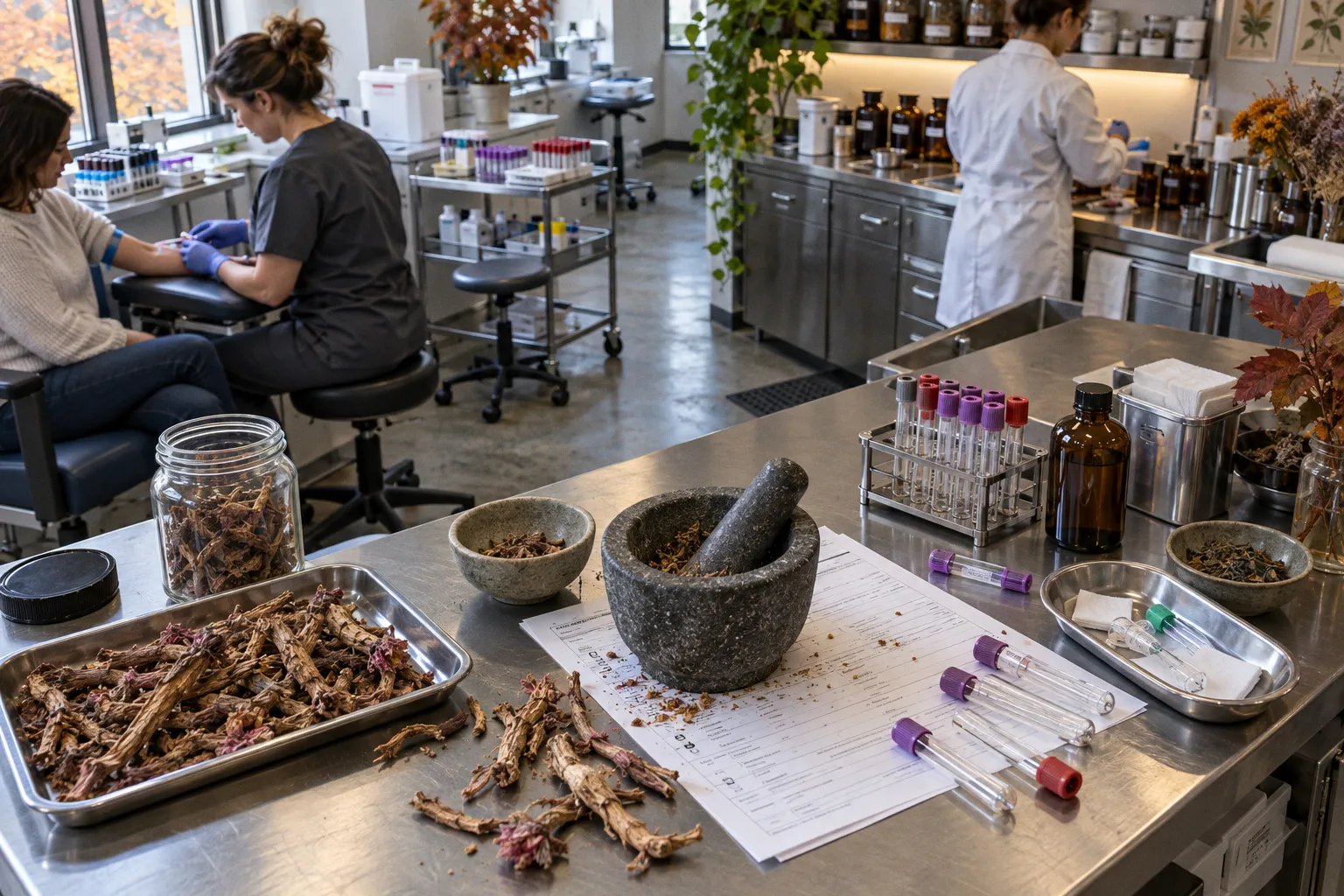
In most patients, the problem is more accurately described as dysregulation of the hypothalamic-pituitary-adrenal axis, altered sleep architecture, persistent psychological stress, medication effects, undernutrition, or an unrelated medical condition.
That distinction matters. Adaptogenic herbs do not refill exhausted adrenal glands like a botanical battery charger. They influence stress-response systems, including the HPA axis, cortisol signaling, heat-shock proteins, inflammatory pathways, and neuroendocrine communication. That is a more useful description—and considerably less marketable than the usual wellness slogan.
The HPA axis: what adaptogens actually regulate
The HPA axis is a control system linking the hypothalamus, pituitary gland, and adrenal cortex.
Under stress, the hypothalamus releases corticotropin-releasing hormone, or CRH. The pituitary responds by releasing adrenocorticotropic hormone, known as ACTH. ACTH then signals the adrenal cortex to produce cortisol. Cortisol helps mobilize glucose, regulate vascular tone, shape immune activity, and maintain energy availability during demand.
The system is governed by feedback. As cortisol rises, it signals the hypothalamus and pituitary to reduce further stimulation. In a healthy response, the axis activates when needed and settles when the stressor passes.
Chronic stress complicates this pattern. The issue is not simply that cortisol becomes high or low. Cortisol may remain elevated, lose its normal daily rhythm, respond poorly to a new stressor, or fluctuate alongside sleep deprivation, inflammation, insulin resistance, and mood disturbance. A single serum cortisol measurement rarely explains that full picture.
The original term adaptogen was coined in 1947 by Soviet pharmacologist Nikolai Lazarev. It referred to substances believed to increase non-specific resistance to stress. The concept was broader than a stimulant and less crude than a sedative. An adaptogen was supposed to improve the organism’s ability to respond to changing demands without forcing one fixed physiological direction.
That principle remains relevant. A useful adaptogenic herb should not be treated as a chemical command to produce more cortisol. Nor should it be marketed as a universal cortisol suppressor. Its effects depend on the plant, extract, dose, duration, baseline physiology, and the type of stress being measured.
Adaptogens do not repair a mythical pair of “tired adrenals.” They modulate a complex stress-response network.
In clinical studies, certain adaptogenic preparations have been associated with reductions in serum cortisol in chronically stressed people. Reported reductions range from 14% to 36%, depending on the herb, extract, study population, and protocol. Those figures are not a guarantee for an individual patient. They are signals of biological activity, not a licence to replace diagnosis with capsules.
From marketing claims to plant chemistry
The useful question is not whether a plant is called an adaptogen. The useful questions are more exact:
- Which species is being used?
- Which plant part is present in the preparation?
- Which constituents have been measured?
- Is the extract standardized?
- What dose was used in human trials?
- Was the outcome cortisol, perceived stress, sleep, fatigue, or something else?
- How long was the intervention continued?
- What medications and conditions were excluded?
Botanical identity comes first. Withania somnifera is not interchangeable with an unspecified “ashwagandha blend.” Rhodiola rosea is not interchangeable with every product sold as rhodiola. Species, chemotype, cultivation conditions, extraction solvent, and marker compounds can materially change the preparation.
Withania somnifera: withanolides and stress response
Ashwagandha, or Withania somnifera, belongs to the Solanaceae family. Its principal researched constituents include withanolides, a group of steroidal lactones. These compounds are not identical to human corticosteroids, despite the lazy tendency of supplement advertising to imply that anything “steroidal” must act like adrenal hormone replacement.
Human trials of standardized W. somnifera extracts have used daily doses ranging from 120 to 1,000 mg over approximately three to 16 weeks. Some trials report meaningful reductions in perceived stress and serum cortisol. In studies lasting around 60 days, serum cortisol reductions of up to 30% have been reported.
The range is wide because the products are not uniform. A root-only preparation differs from a root-and-leaf extract. A preparation standardized by total withanolide content is not automatically equivalent to one standardized by a specific withanolide profile. The label may display a milligram quantity that looks precise while concealing substantial chemical variation.
Ashwagandha is often presented as suitable for every stressed person. That is poor pharmacology. The herb can cause gastrointestinal symptoms, drowsiness, or other adverse effects. Caution is warranted in people with thyroid disorders, autoimmune disease, liver disease, or sensitivity to sedating agents. Pregnancy and breastfeeding require professional assessment rather than internet improvisation.
The thyroid issue deserves particular restraint. Ashwagandha may influence thyroid-related measures in some settings, but this does not make it a treatment for hypothyroidism. A person taking levothyroxine or another thyroid medication should not add a pharmacologically active botanical and assume that “natural” means irrelevant to laboratory results.
Rhodiola rosea: rosavins, salidroside, and fatigue
Rhodiola rosea is a member of the Crassulaceae family. Its commonly discussed constituents include rosavins and salidroside, also called tyrosol glycoside. The plant has a long history of use in traditional European and Eurasian herbal practice, particularly for fatigue and reduced work capacity.
Clinical protocols have used daily doses from approximately 290 to 1,500 mg over three to 16 weeks. This does not establish one universal dose. It demonstrates the breadth of preparations and trial designs. Rhodiola products can differ sharply in the ratio of rosavins to salidroside, and some commercial products do not make that ratio clear.
The herb is frequently described as energizing. That description is incomplete. Rhodiola is not equivalent to caffeine, amphetamine, or another central nervous system stimulant. Its clinical purpose, where it proves useful, is closer to supporting stress tolerance and reducing fatigue-related impairment than forcing continuous arousal.
That distinction becomes practical when insomnia is present. A stimulating-feeling botanical taken late in the day may worsen sleep, regardless of what the marketing copy promises. People with bipolar-spectrum conditions should use particular caution with agents that may affect activation, sleep, or mood. Medication interactions also require review, especially when antidepressants, stimulants, or other psychoactive drugs are involved.
Holy basil and the limits of broad claims
Holy basil, or Ocimum tenuiflorum—also known as Ocimum sanctum—is another plant commonly grouped with adaptogens. Its phytochemistry includes volatile terpenes and phenylpropanoids, with eugenol among the better-known constituents. Traditional use is extensive, but traditional use does not automatically establish a defined clinical effect for every modern extract.
Claims about “holy basil benefits for the nervous system” should therefore remain proportionate. The plant may be relevant to stress-support protocols, but evidence quality, preparation, dose, and patient context matter. A tea, a tincture, and a concentrated standardized extract are pharmacologically different objects. Treating them as interchangeable is how herbal medicine acquires a reputation for vagueness.
Molecular mechanisms: beyond simple cortisol regulation
Cortisol is only one visible output of the stress system. Adaptogens have been investigated for effects on several molecular pathways involved in cellular stress and recovery.
Heat-shock proteins
Heat-shock proteins act as molecular chaperones. They help maintain protein structure during physiological strain and assist with repair or removal of damaged proteins. Hsp70 is one of the stress-response mediators studied in connection with adaptogenic activity.
This does not mean an adaptogenic herb “boosts immunity” in the simplistic commercial sense. It means that some plant constituents may influence cellular systems involved in protein protection and stress adaptation. The effect is mechanistic, not mystical.
JNK1 and stress signaling
Stress-activated c-Jun N-terminal kinase 1, or JNK1, participates in intracellular signaling associated with inflammation, metabolic stress, and cellular adaptation. Research on adaptogens has examined how botanical constituents interact with stress-activated kinase pathways.
The practical interpretation remains cautious. A molecular effect observed in cell systems does not automatically translate into a clinically meaningful outcome in a person taking a capsule. Concentration, absorption, metabolism, tissue distribution, and formulation all intervene between a laboratory finding and a treatment recommendation.
FOXO transcription factors
FOXO proteins regulate genes involved in oxidative stress response, metabolism, cell survival, and repair. Their activity is influenced by insulin signaling, energy balance, and other pathways. Adaptogenic research frequently places FOXO within a broader network of cellular stress regulation.
Again, the presence of FOXO in a mechanistic diagram is not evidence that a product extends life, reverses ageing, or repairs every consequence of chronic stress. That is the point at which pharmacology ends and supplement theatre begins.
Nitric oxide and neuroendocrine communication
Nitric oxide contributes to vascular function, neural signaling, and immune regulation. Adaptogenic compounds may influence nitric oxide pathways, but the direction and clinical importance vary by plant and experimental model.
The larger point is that adaptogens appear to act as network modulators. They do not operate through one single “adrenal” mechanism. Their effects may involve the HPA axis, autonomic balance, inflammatory signaling, oxidative stress, and central nervous system pathways at the same time.
That complexity is one reason results are inconsistent. It is also why a product can reduce perceived stress in one population while offering little benefit to another.
What the clinical evidence supports
The strongest practical case for adaptogenic herbs is not the treatment of adrenal insufficiency. It is adjunctive support for selected adults experiencing stress-related fatigue, perceived overload, sleep disturbance, or reduced resilience, after more serious causes have been considered.
The evidence is more credible when the following elements are present:
1. The botanical is correctly identified. The Latin binomial and plant part should be stated clearly.
2. The extract is chemically described. Standardization to marker compounds is more informative than a large number of undifferentiated milligrams.
3. The outcome is measurable. Cortisol, validated stress scales, sleep measures, and fatigue scores are more useful than vague promises about balance.
4. The intervention has a defined duration. Most cited clinical protocols run for several weeks, not two days.
5. The preparation resembles the one studied. Evidence for a standardized extract cannot automatically be transferred to an unstandardized powder.
6. The patient has been screened for confounders. Anaemia, thyroid disease, sleep apnoea, depression, infection, medication effects, and inadequate caloric intake can all present as “burnout.”
The phrase “adaptogens for hormonal balance” is particularly imprecise. Hormonal systems are not a single dashboard with one slider marked balance. Cortisol, thyroid hormones, reproductive hormones, insulin, and catecholamines operate through different regulatory systems. A botanical that affects one pathway may have no useful effect on another and may complicate treatment in a susceptible person.
A lower cortisol number is not automatically a healthier physiology. The question is whether the person functions better without creating a new problem.
Ashwagandha and rhodiola: a practical comparison
| Parameter | Withania somnifera | Rhodiola rosea |
|---|---|---|
| Botanical family | Solanaceae | Crassulaceae |
| Common marker compounds | Withanolides | Rosavins and salidroside |
| Typical research focus | Perceived stress, cortisol, sleep, stress-related fatigue | Fatigue, mental performance under stress, perceived exhaustion |
| Daily doses used in clinical trials | Approximately 120–1,000 mg of standardized extracts | Approximately 290–1,500 mg of studied preparations |
| Study duration in reviewed trials | About 3–16 weeks | About 3–16 weeks |
| Reported cortisol finding | Reductions of up to 30% in some 60-day trials | Cortisol effects are less uniform and depend strongly on protocol |
| Main practical concern | Sedation, gastrointestinal effects, thyroid and autoimmune considerations | Sleep disruption, activation, mood sensitivity |
| Product-quality problem | Root versus root-and-leaf extracts; variable withanolide profiles | Variable rosavin-to-salidroside ratios and inconsistent standardization |
The table is not a prescribing schedule. It is a reminder that a plant name is not a complete pharmaceutical description.
Dosage, timing, and duration
The phrase “ashwagandha dosage for stress” tends to produce a single number. The evidence does not support that level of certainty. Clinical trials have used a broad range of standardized doses, from 120 to 1,000 mg daily. The correct interpretation is not that every dose in that interval is suitable for every person. It is that formulation and standardization must be read before the number means anything.
A sensible clinical approach is conservative:
- Begin with the lowest dose that resembles the preparation used in human research.
- Take the product consistently rather than changing the dose every few days.
- Use morning or midday timing if the preparation feels activating.
- Use evening timing only if sedation is intended and tolerated.
- Reassess after several weeks, not after a single serving.
- Stop if there is persistent gastrointestinal distress, marked drowsiness, agitation, palpitations, rash, or a clear deterioration in sleep.
- Do not combine multiple adaptogens immediately. If several products are started at once, the response becomes impossible to attribute.
Rhodiola is commonly better suited to earlier dosing because some people experience increased alertness. Ashwagandha may be more sedating for some users, although individual responses vary. Tea, tincture, powder, and dry extract should not be treated as equivalent units. A tincture’s volume does not reveal its actual concentration unless the extraction ratio and solvent are known.
Product labels deserve scrutiny. A serious label should identify:
- The full Latin species name.
- The plant part used.
- The extraction ratio or standardized marker content.
- The amount per serving.
- Batch and contaminant testing where available.
- Warnings relevant to pregnancy, medications, and chronic disease.
A proprietary blend that hides the dose of each botanical is not sophisticated. It is simply less accountable.
When “burnout” requires a medical work-up
Persistent exhaustion is a symptom, not a botanical diagnosis. Adaptogenic herbs for adrenal fatigue recovery should never be used to postpone assessment of potentially serious disease.
Medical review is warranted when fatigue is severe, progressive, or accompanied by unexplained weight loss, fainting, persistent vomiting, significant weakness, fever, bleeding, shortness of breath, chest pain, marked changes in blood pressure, or pronounced skin pigmentation. These symptoms require proper evaluation, not a stronger tincture.
Known adrenal insufficiency is a separate medical condition. It can require standard hormone replacement and urgent treatment during physiological stress. Adaptogens do not replace that care. They do not treat an acute adrenal crisis. They do not substitute for assessment of pituitary or adrenal disease.
The same discipline applies to sleep. A person sleeping five hours because of night-shift work, caregiving, alcohol use, untreated sleep apnoea, or chronic pain does not have a simple herb deficiency. No botanical can compensate indefinitely for a destabilized schedule and inadequate recovery.
Diet matters as well. Severe energy restriction, low protein intake, iron deficiency, inadequate carbohydrate availability during heavy training, and erratic meals can all amplify fatigue and stress symptoms. Whole-food nutrition is not a decorative companion to herbal therapy. It is part of the physiological substrate on which any intervention must operate.
The narrow case for adaptogenic therapy
Adaptogens are neither fraudulent by definition nor magical by default. They are pharmacologically active plants with uneven evidence, variable preparations, and real contraindications.
Withania somnifera has the clearest place in discussions of stress-related cortisol reduction among the herbs covered here, although the clinical effects remain preparation-dependent. Rhodiola rosea is more plausibly considered when fatigue and reduced stress tolerance dominate, particularly if the product is chemically characterized and dosing is controlled. Holy basil may have a role in broader stress-support practice, but sweeping nervous-system claims should be treated with the same suspicion applied to any unsupported supplement promise.
The disciplined position is straightforward:
- Use botanical names, not marketing categories.
- Evaluate extracts by constituents and trial design.
- Treat cortisol as one measurement, not a verdict.
- Avoid the false diagnosis of “adrenal fatigue.”
- Screen for medication interactions and underlying disease.
- Use defined doses for defined periods.
- Stop when adverse effects appear.
I have yet to see a credible reason to call every exhausted person hormonally depleted. I have seen good reasons to examine sleep, nutrition, medication, mental health, endocrine function, and the actual chemistry of the herb being proposed. Adaptogens may support a dysregulated stress response. They do not exempt anyone from physiology, diagnosis, or dosage discipline.