Turmeric bioavailability: data on curcumin absorption rates
Turmeric is not a reliable proxy for curcumin exposure. The rhizome of Curcuma longa contains only about 1%–6% curcuminoids by dry weight, and unmodified oral curcumin typically shows systemic bioavailability below 1%.
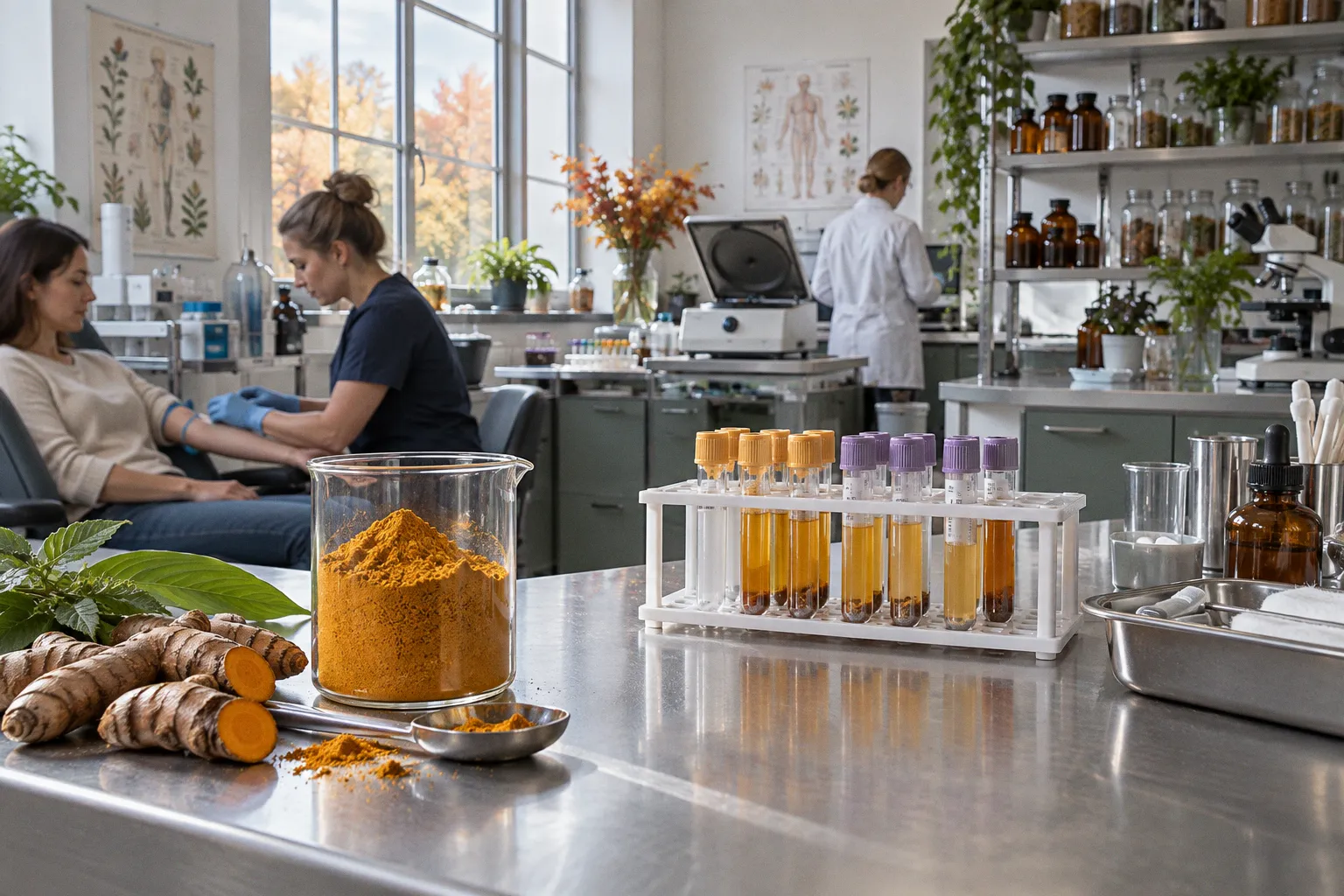
Most of the compound is poorly dissolved, rapidly conjugated in the intestinal wall and liver, and eliminated before it can circulate in meaningful quantities.
That is the central problem behind turmeric curcumin bioavailability for inflammation reduction. The marketing language usually starts with the chemistry of the plant and ends with a promise about the human body. Pharmacokinetics is less accommodating. A compound can be pharmacologically interesting and still fail to reach the bloodstream in a useful form.
The metabolic barrier: why raw turmeric struggles to reach the bloodstream
Curcumin is the primary bioactive polyphenol associated with turmeric’s anti-inflammatory reputation. It is not, however, a freely soluble molecule. Its poor aqueous solubility limits dissolution in the gastrointestinal tract. What does dissolve is then exposed to rapid metabolism in the gut wall and liver.
The result is a familiar pharmacological mismatch: a high amount swallowed, followed by a very small amount detected systemically.
Unmodified oral curcumin generally has reported bioavailability below 1%. That figure is not a minor technical inconvenience. It changes how the compound should be evaluated. A capsule containing a large nominal dose does not mean that the same quantity reaches plasma, tissues, or inflammatory pathways.
Several processes contribute to the low exposure:
- Poor water solubility restricts the amount available for intestinal uptake.
- Intestinal glucuronidation converts curcumin into conjugated metabolites before substantial systemic circulation occurs.
- Hepatic first-pass metabolism further reduces the quantity of unchanged compound.
- Rapid elimination limits the duration of measurable circulating levels.
- Efflux transport can move absorbed material back into the intestinal lumen, reducing net uptake.
This is why turmeric powder and standardized curcumin extract should not be treated as interchangeable. Turmeric is a botanical matrix containing curcuminoids alongside volatile oils, starches, proteins, and other constituents. Curcumin extract is a concentrated chemical fraction. Neither category automatically solves the absorption problem.
The dry rhizome usually contains approximately 1%–6% curcuminoids. The range is broad enough to make kitchen measurements pharmacologically imprecise. A spoonful of turmeric powder does not represent a defined curcuminoid dose, and it certainly does not establish a predictable plasma concentration of curcuminoids.
A large label dose is not the same thing as a large systemic exposure. Curcumin’s first opponent is not inflammation. It is pharmacokinetics.
The distinction matters in clinical discussions. A study using a formulated curcumin preparation cannot be casually translated to ordinary turmeric used in food. Conversely, a positive result with a high-bioavailability product does not prove that raw root powder can produce the same anti-inflammatory effect.
Piperine and glucuronidation: the mechanism behind the 20-fold increase
The best-known strategy for improving curcumin absorption rates with black pepper is the addition of piperine, an alkaloid found principally in Piper nigrum. Piperine is not simply a culinary companion added for tradition or flavor. It has measurable effects on drug and nutrient handling.
In a seminal human study involving eight healthy volunteers, 2 g of curcumin given with 20 mg of piperine produced a reported 2,000% increase in curcumin bioavailability. Expressed differently, the combination produced approximately a 20-fold increase in the area-under-the-curve exposure ratio compared with curcumin alone.
That result is substantial. It is also frequently abused by supplement marketing.
The study establishes a change in measured bioavailability under the tested conditions. It does not establish a 20-fold increase in pain relief, joint function, or systemic inflammation reduction. Pharmacokinetic improvement and clinical efficacy are related questions, not interchangeable answers.
Piperine appears to improve exposure through several mechanisms:
1. Inhibition of glucuronidation. Piperine inhibits uridine diphosphate-glucuronosyltransferase enzymes, commonly referred to as UGT enzymes. These enzymes attach glucuronic acid to compounds and facilitate their elimination.
2. Reduction of P-glycoprotein efflux. P-glycoprotein can transport absorbed compounds back into the intestinal lumen. Inhibiting this pump may increase net uptake.
3. Changes in intestinal permeability and membrane dynamics. Piperine can alter the behavior of intestinal cell membranes.
4. Increased intestinal blood flow. This may support absorption and transport, although it does not turn every swallowed molecule into active circulating curcumin.
The phrase “increased bioavailability” also requires precision. Depending on the analytical method, blood measurements may include unconjugated curcumin, glucuronidated metabolites, sulfate conjugates, or other measured forms. Higher total plasma exposure does not necessarily mean a proportional rise in free, pharmacologically active curcumin.
That distinction is particularly relevant when comparing products. A label may cite a dramatic relative increase against standard curcumin while saying little about the absolute plasma concentration achieved, the fraction that remains unconjugated, or whether the formulation was studied in people with inflammatory disease rather than healthy volunteers.
Why piperine is not an innocent add-on
Piperine’s ability to inhibit metabolic enzymes and transporters is precisely why it can raise curcumin exposure. It is also the reason for caution.
The same mechanisms may alter the handling of medicines taken at the same time. A compound that inhibits glucuronidation or P-glycoprotein does not recognize the commercial category “supplement.” It interacts with biological systems, and those systems also process prescription drugs.
People taking medicines with a narrow therapeutic range, anticoagulants, antiplatelet drugs, antiepileptic medicines, immunosuppressants, or other drugs extensively metabolized by the liver should not add high-dose piperine-containing curcumin without professional review. The concern is not that piperine is inherently poisonous at every culinary exposure. The concern is that concentrated extract doses are pharmacologically different from a dusting of black pepper on food.
Beyond the root: phytosomes, hydrophilic carriers, and standard powder
Piperine is only one approach. Modern curcumin products increasingly use delivery systems designed to address solubility, intestinal transport, or both. These include phospholipid complexes, phytosomes, hydrophilic carriers, and cellulosic derivatives.
A comparative study in healthy volunteers evaluated different curcumin formulations against unformulated standard curcumin. The results showed substantial differences:
| Formulation or approach | Reported result compared with standard curcumin | Main pharmacokinetic logic |
|---|---|---|
| Unformulated curcumin | Baseline; typically below 1% systemic bioavailability | Poor solubility and rapid metabolism |
| Curcumin with piperine | Approximately 20-fold increase in the seminal human study | Reduced glucuronidation and efflux |
| Curcumin phytosome | 7.9-fold increase in total blood curcuminoids | Association with phospholipid structures to improve absorption |
| Hydrophilic carrier or cellulosic derivative | 45.9-fold increase in the comparative study | Improved dispersion and aqueous handling |
These figures are useful for comparing formulation performance. They are not interchangeable clinical endpoints.
A 45.9-fold increase in blood curcuminoids over an unformulated reference does not mean that a person receives 45.9 times the anti-inflammatory benefit. The comparison is relative, and the baseline is poor. Multiplying a low number can produce a large percentage while leaving unanswered questions about tissue distribution, free curcumin, duration of exposure, and clinical response.
The same caution applies to the popular comparison of liposomal curcumin versus standard powder. Liposomal or lipid-associated delivery may improve dispersion and absorption, but the label alone cannot establish superiority. The relevant questions are more exact:
- Was the product compared with unformulated curcumin or with another enhanced formulation?
- Were total curcuminoids measured, or only unconjugated curcumin?
- Was the study conducted in healthy volunteers or patients with a defined condition?
- Was the measured difference sustained long enough to matter clinically?
- Did the trial assess pain, function, inflammatory markers, or only plasma exposure?
- Was the exact commercial formulation used in the published study?
Without those answers, “liposomal” remains a formulation description, not a guarantee of therapeutic performance. Supplement packaging has a habit of treating delivery technology as if it were an outcome. It is not.
The chemical profile matters more than the headline
Turmeric contains several curcuminoids, with curcumin commonly treated as the principal component. It also contains volatile oils and other plant constituents. A standardized extract can provide greater batch consistency than culinary powder, but standardization narrows the chemical question. It does not resolve every issue related to absorption or efficacy.
The practical distinction is this:
- Food-level turmeric supplies a variable, relatively dilute amount of curcuminoids.
- Standardized turmeric extract supplies a more defined amount but may still have low absorption.
- Piperine-enhanced curcumin can produce much higher systemic exposure, with greater interaction potential.
- Phytosome or hydrophilic formulations use a delivery strategy intended to improve absorption, but the specific product and study design matter.
A product should therefore be judged by its formulation data, not by the reputation of the plant. Botanical identity is necessary. It is not sufficient.
Translating plasma concentration into anti-inflammatory efficacy
The question readers usually care about is not whether curcumin appears in blood. It is whether it reduces pain, stiffness, or inflammatory activity.
Those outcomes require separate evidence.
The available pharmacokinetic findings demonstrate that formulation can alter circulating curcuminoid levels dramatically. They do not prove that every increase in plasma exposure produces a proportional improvement in inflammatory disease. The research record leaves important uncertainties about how much of the measured material is free curcumin, how long it persists, where it distributes, and which patient groups respond.
This is where the phrase turmeric anti-inflammatory efficacy data needs discipline. Data on absorption are not automatically data on treatment.
A useful evidence chain has at least four stages:
1. Chemical content: How much curcuminoid is present in the raw material or finished product?
2. Systemic exposure: How much reaches plasma, in what chemical form, and for how long?
3. Biological activity: Does the exposure influence relevant inflammatory pathways or biomarkers?
4. Patient outcome: Does the person experience measurable improvement in pain, function, or disease control?
Many commercial claims stop after stage two. Some do not even reach that point, relying instead on the historical use of turmeric as proof of modern supplement performance. Historical use can justify investigation. It cannot replace pharmacokinetic or clinical evidence.
The same logic applies to natural pain relief herbs more broadly. Traditional botanical medicine has produced useful pharmacological leads, but tradition is not a dose-response curve. A plant’s long use does not establish that a concentrated extract is safe with current medications, nor that a modern delivery system produces the same effect as food.
I have yet to see a serious pharmacological argument improved by the word “natural.” The useful questions are concentration, absorption, metabolism, target, dose, duration, and risk.
What the bioavailability figures can and cannot tell us
The main findings can be stated without promotional inflation:
- Raw, unformulated curcumin generally has systemic bioavailability below 1%.
- Piperine co-administration can increase measured exposure substantially; one human study reported a 20-fold increase with 2 g curcumin and 20 mg piperine.
- A phytosome formulation produced a 7.9-fold increase in total blood curcuminoids compared with standard curcumin in a comparative study.
- A hydrophilic carrier or cellulosic derivative produced a 45.9-fold increase in the same general type of comparison.
- None of these figures guarantees a matching increase in anti-inflammatory efficacy.
- The analytical form of curcumin measured in plasma remains relevant to interpretation.
These are pharmacokinetic results, not permission to escalate the dose indefinitely. Higher exposure can increase the possibility of adverse effects and interactions alongside any potential benefit.
Therapeutic dosage of turmeric for pain: where precision ends
There is no single therapeutic dosage of turmeric that can be transferred across food, powder, extract, piperine-enhanced capsules, phytosomes, and hydrophilic formulations. The 2 g curcumin plus 20 mg piperine regimen from the seminal study is a research dose used under controlled conditions. It should not be presented as a universal prescription for pain or systemic inflammation.
The amount of curcuminoids in turmeric powder is variable. The amount absorbed from that powder is more variable still. A product standardized to curcuminoid content provides better chemical definition, but its clinical relevance depends on the delivery system and the population studied.
For practical evaluation, a formulation label should make several details visible:
- botanical source and plant part: Curcuma longa rhizome;
- total curcuminoid content rather than turmeric weight alone;
- whether piperine is present and at what amount;
- whether the product uses a phytosome, lipid complex, hydrophilic carrier, or other delivery system;
- serving size and number of capsules required;
- testing for identity, contaminants, and batch consistency;
- warnings about medication interactions and relevant medical conditions.
The presence of black pepper extract should not be treated as an automatic advantage. Piperine may improve absorption, but it also changes metabolic handling. A piperine-free formulation may be preferable for someone taking interacting medicines, while another person may require a clinician’s assessment before using any concentrated curcumin product.
Curcumin and turmeric supplements also warrant caution in people with gallbladder or biliary disease, bleeding disorders, upcoming surgery, significant liver disease, or complex medication regimens. Pregnancy and breastfeeding require individualized medical guidance rather than generic supplement advice. Concentrated extracts are not equivalent to the culinary use of turmeric in ordinary food.
The safest principle is unglamorous: use the lowest studied amount appropriate to the specific formulation, do not stack multiple curcumin products, and do not treat a larger plasma concentration as a substitute for diagnosis or medical treatment.
Standard powder versus enhanced formulation
For a person deciding between standard turmeric powder and a formulated curcumin product, the distinction is not merely price or branding.
Standard powder is chemically variable and poorly suited to precise dosing. It may be entirely reasonable as a food ingredient. It is a weak basis for claims about therapeutic serum levels.
A standardized extract offers more predictable curcuminoid content, but unformulated extract still faces the absorption barrier. Enhanced products can increase exposure, sometimes by a wide margin, yet their clinical value depends on evidence for the exact formulation.
This creates a hierarchy of claims:
1. Turmeric contains curcuminoids. Straightforward.
2. Curcuminoids have pharmacological activity in experimental systems. Plausible and well established as a mechanistic statement.
3. A formulation increases plasma curcuminoid exposure. Supported when shown in a controlled pharmacokinetic study.
4. The formulation reduces pain or inflammation in a defined patient population. Requires clinical outcome data.
5. The product replaces anti-inflammatory treatment. A much stronger claim and generally unjustified without robust disease-specific evidence.
The further a claim travels down that list, the less acceptable it becomes to rely on absorption data alone.
The practical conclusion on turmeric curcumin bioavailability
Turmeric is a useful botanical source of curcuminoids, but raw turmeric is not a dependable delivery system for systemic curcumin. Unmodified curcumin commonly shows bioavailability below 1%. Piperine can increase exposure sharply by inhibiting glucuronidation, P-glycoprotein efflux, and related processes. Phytosomes and hydrophilic carriers can produce even larger relative increases over standard curcumin in pharmacokinetic comparisons.
Those numbers matter. They explain why formulations differ and why a kitchen jar of turmeric powder cannot be used as a substitute for a studied extract. They do not prove that a 20-fold or 45.9-fold increase in circulating curcuminoids produces the same multiple of clinical benefit.
The correct interpretation is narrower and more useful: curcumin absorption is a formulation problem before it is a dosage problem. Solve absorption poorly, and the nominal dose says little. Solve it aggressively, and interaction risks become more relevant.
Piperine-enhanced and high-bioavailability curcumin products should therefore be treated as pharmacologically active supplements, not harmless spices in capsule form. Dose according to the studied formulation, avoid casual escalation, and review contraindications and drug interactions before use. The plant is traditional. The pharmacokinetics are not optional.