Oxalate levels in leafy greens: a data-driven analysis
Oxalate content in leafy greens varies by more than two orders of magnitude. A cup of raw spinach contains approximately 656 mg of oxalate. The same volume of chopped kale contains about 2 mg.
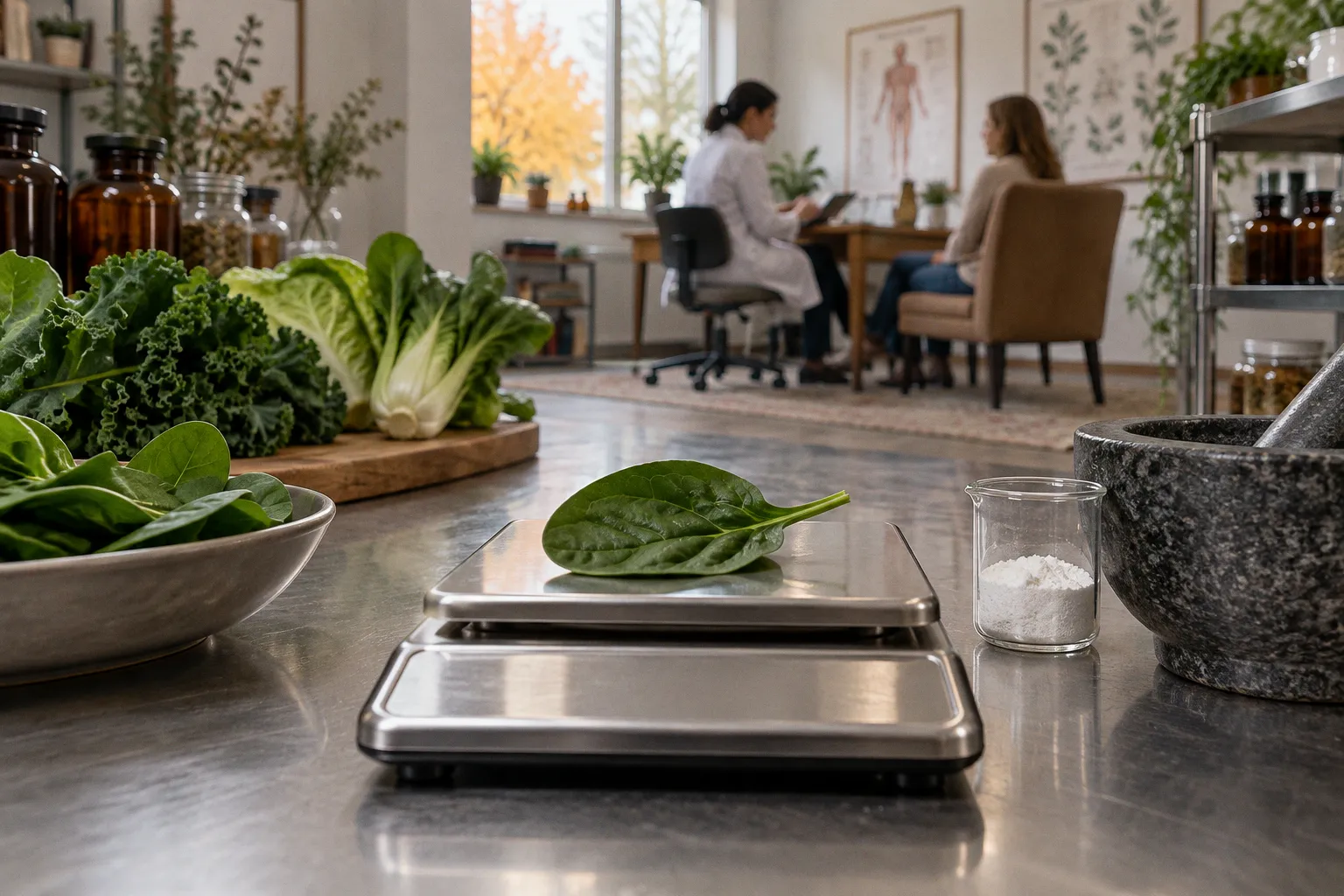
Romaine lettuce may contain no measurable oxalate in a standard serving.
This difference changes the nutritional interpretation of the category. “Leafy greens” is not a chemically uniform group. Spinach, Swiss chard, beet greens, kale, bok choy, arugula, and romaine differ substantially in oxalate density, mineral-binding potential, and response to cooking.
For most people, dietary oxalate is only one variable in a broader dietary pattern. For individuals with calcium oxalate kidney stones, hyperoxaluria, reduced kidney function, or a clinical history suggesting impaired oxalate handling, the distinction becomes more relevant. The practical issue is not whether greens are healthy. It is which greens are being consumed, in what quantity, and with which preparation method.
Leafy green color does not predict oxalate content. Spinach and kale occupy opposite ends of the relevant spectrum.
The oxalate spectrum: spinach is not interchangeable with kale
Oxalates are organic acids found in many plant foods. In the digestive tract, oxalate can bind minerals, particularly calcium. The resulting complexes may remain in the intestinal lumen and pass through the gastrointestinal tract. The fraction that remains soluble is more available for absorption.
The concentration differs sharply among vegetables. The following comparison uses approximate serving-level values from the available data.
| Leafy green | Approximate oxalate content | Practical classification |
|---|---|---|
| Romaine lettuce, 1 cup | 0 mg | Very low |
| Kale, 1 cup chopped | 0–2 mg | Very low |
| Bok choy, 1 serving | 0–2 mg | Very low |
| Iceberg lettuce, 1 serving | 0–2 mg | Very low |
| Arugula, 1 cup raw | About 7 mg | Low |
| Watercress, 1 serving | About 7–15 mg | Low to moderate |
| Beet greens or Swiss chard, 2 cups raw | About 300–500 mg | High |
| Spinach, 1 cup raw | About 656 mg | Very high |
The category labels are relative. A low-oxalate food is not necessarily free of oxalate, and a high-oxalate vegetable is not automatically inappropriate. The relevant variable is exposure: serving size multiplied by frequency, adjusted for preparation and the rest of the meal.
Kale, bok choy, and romaine therefore provide a useful alternative when a person wants high-volume leafy vegetables without the oxalate burden associated with raw spinach or chard. They are not nutritionally identical. Their profiles differ in vitamin K, carotenoids, folate, calcium, fiber, and glucosinolate content. But from an oxalate-management perspective, they are not minor substitutions.
A high-oxalate vegetable list requires serving context
A food database may report values per 100 g, per cup, or per cooked portion. These are not interchangeable measurements. Raw leafy vegetables contain substantial water and occupy considerable volume. Cooking reduces volume and changes the weight-to-serving relationship.
This creates a common analytical error. A person compares one cup of raw spinach with one cup of cooked spinach as though these represent the same amount of vegetable. They do not. Cooking collapses the leaf structure, allowing a larger mass of spinach to fit into the same volume. A cooked serving can therefore contain a high oxalate load even when the visual portion appears small.
The available figures illustrate this concentration effect. Raw spinach contains approximately 656 mg of oxalate per cup. A half-cup serving of cooked spinach has been reported at approximately 755 mg. The values should not be interpreted as a simple cooking increase. The serving definitions and water-loss effects differ. The key point is more practical: cooked spinach can remain a concentrated oxalate source because cooking changes volume as well as chemistry.
Swiss chard and beet greens follow the same general pattern. Approximately two cups raw may provide 300–500 mg of oxalate. The exact value is variable. Cultivar, soil conditions, maturity, storage, preparation, and analytical method can all affect the result.
Why spinach and chard lead the charts
Oxalate is not distributed evenly across plant tissues. Some species accumulate larger quantities as part of normal plant metabolism and mineral regulation. Spinach and chard are prominent examples among commonly consumed greens.
The clinical relevance depends on three processes:
1. Dietary delivery. The vegetable supplies soluble and insoluble oxalate to the gastrointestinal tract.
2. Intestinal binding. Calcium and other minerals can bind oxalate within the gut.
3. Absorption and renal excretion. Unbound oxalate may be absorbed, circulate, and eventually be filtered by the kidneys.
This sequence explains why the oxalate content of a food is not equivalent to its systemic oxalate exposure. The body does not absorb the entire measured amount. The absorbed fraction varies between individuals and depends on meal composition, intestinal conditions, kidney function, and the gut microbiome.
The phrase “dietary oxalate absorption rates” therefore requires precision. There is no single absorption percentage that applies to every person and every serving. The available information does not establish an exact individual systemic absorption rate. Microbiome composition is one unresolved variable. The presence and activity of oxalate-degrading organisms, including Oxalobacter formigenes, may influence handling, but the individual effect cannot be reduced to a universal protocol.
Kidney stone risk is similarly multifactorial. Oxalate is relevant to calcium oxalate stone formation, but urinary calcium, fluid intake, sodium intake, citrate status, total dietary pattern, and renal physiology also matter. A food-level oxalate value should not be converted directly into a personal risk estimate.
The practical conclusion is narrower and more reliable: people with a documented tendency toward calcium oxalate stones may benefit from reducing repeated exposure to very high-oxalate portions, especially when those portions are consumed without a calcium source.
The clinically relevant unit is not the raw vegetable in isolation. It is the oxalate dose that reaches the intestine within a specific meal.
Cooking changes soluble oxalate, not the identity of the food
The most effective preparation method in the available data is boiling. High-oxalate vegetables are cooked in water, and soluble oxalate leaches into the cooking liquid. Draining the water removes part of that soluble fraction.
This is a chemical extraction process. It is not detoxification, and it does not eliminate all oxalate from the vegetable. Insoluble oxalate remains. Some soluble oxalate remains within the plant tissue. The magnitude of reduction depends on the vegetable, cut size, water volume, cooking time, and whether the cooking liquid is consumed.
Boiling versus other cooking methods
Boiling is distinct from steaming, sautéing, roasting, or blending because the food is in direct contact with a relatively large volume of water. Dry-heat methods may soften the plant and reduce volume, but they do not provide the same leaching pathway. If the cooking liquid is retained in a soup or sauce, the extracted oxalate remains in the meal.
A practical preparation protocol for high-oxalate greens is straightforward:
1. Use a sufficient volume of water to maintain contact between the leaves and the cooking liquid.
2. Boil the greens rather than merely warming them in a dry pan.
3. Drain the cooking water.
4. Avoid using that liquid as stock when the purpose is to reduce soluble oxalate exposure.
5. Treat the cooked portion as concentrated food. Do not assume that a smaller volume equals a smaller oxalate dose.
6. Pair the meal with a calcium-containing food when clinically appropriate.
The method is more relevant for spinach, chard, and beet greens than for kale, romaine, or bok choy. Applying aggressive reduction techniques to low-oxalate greens offers little additional benefit and may reduce palatability or nutrient retention without a clear clinical advantage.
Raw, boiled, and blended preparations
Raw spinach is especially easy to overconsume because it collapses rapidly in smoothies and salads. A large quantity can be ingested within minutes. Blending does not remove oxalate. It changes particle size and increases the speed at which the full portion is consumed.
Boiling followed by draining addresses the soluble fraction. Blending does not. Juicing does not reliably solve the problem either, particularly if the liquid fraction retains soluble oxalate. A green beverage built around spinach can therefore deliver a high oxalate dose while appearing nutritionally concentrated and physically small.
For individuals who require stricter oxalate management, the distinction between “one handful” and a measured serving matters. Leafy greens are highly compressible. Volume estimates are unstable once the leaves are packed into a blender or measuring cup.
Calcium pairing reduces intestinal oxalate availability
Calcium changes oxalate handling before absorption. When calcium is present in the intestinal lumen, it can bind oxalate and form a less absorbable complex. The available data indicate that adding dietary calcium sources can reduce intestinal oxalate availability by approximately 32% to 100%, depending on the conditions.
This range is wide. It should not be interpreted as a guaranteed reduction for every meal. The result depends on the calcium dose, the amount and form of oxalate, timing, meal composition, and individual gastrointestinal physiology.
Suitable calcium sources may include dairy foods, calcium carbonate, or calcium sulphate. The underlying mechanism is not specific to a wellness product. It is a binding interaction within the digestive tract.
Timing and meal structure
Calcium is most relevant when consumed with the oxalate-containing meal. Taking calcium at a separate time may not provide the same intestinal binding effect because the two compounds need to be present in the same digestive phase.
Examples of practical pairings include:
- Boiled spinach served with a calcium-containing dairy food.
- A high-oxalate vegetable meal combined with a measured calcium source selected according to clinical guidance.
- A mixed meal containing low-oxalate greens, tofu prepared with calcium sulphate, or another established calcium-containing food.
The purpose is not to make a high-oxalate food risk-free. The purpose is to reduce the amount of soluble oxalate available for absorption. This is a mitigation strategy, not a license to increase portion size.
Calcium restriction can be counterproductive for some people concerned about calcium oxalate stones. Removing calcium from the diet may reduce the mineral available to bind oxalate in the intestine. Individual calcium requirements and kidney-stone management should be coordinated with a qualified clinician, particularly when there is reduced renal function or a history of recurrent stones.
Low-oxalate greens provide a simpler baseline
For routine use, low-oxalate greens reduce the need for complex preparation. Kale, romaine, iceberg lettuce, and bok choy provide a broad range of culinary applications with approximately 0–2 mg of oxalate per serving in the available data.
Arugula and watercress occupy an intermediate position. Their oxalate content is higher than that of romaine or kale but substantially lower than raw spinach. They can add bitterness, pungency, and micronutrient density without creating the same exposure profile as a large spinach-based smoothie.
This does not make low-oxalate greens universally superior. Nutritional efficacy depends on the target. Spinach is a source of folate, carotenoids, and other nutrients. The issue is dose and context. A person with no known oxalate-related condition may include spinach as part of a varied diet. A person with recurrent calcium oxalate stones may choose kale or bok choy more often and reserve spinach for boiled, drained, calcium-paired meals.
The decision is therefore a protocol question rather than a moral classification of foods.
A practical substitution matrix
| If the usual choice is… | Consider using… | Reason |
|---|---|---|
| Raw spinach in salads | Romaine, kale, or bok choy | Similar leafy volume with much lower oxalate content |
| Spinach smoothie | Low-oxalate greens or a mixed formula with a smaller spinach portion | Blending does not reduce oxalate and can facilitate rapid consumption |
| Swiss chard as a daily green | Kale, romaine, or watercress more frequently | Reduces repeated exposure to a high-oxalate vegetable |
| Cooked spinach | Boiled and drained spinach with a calcium-containing meal | Removes part of the soluble oxalate and limits intestinal availability |
| Beet greens in large portions | A smaller portion with low-oxalate greens | Controls total oxalate dose without eliminating vegetables |
The matrix is not a treatment plan. It is a method for reducing one dietary variable while preserving fiber, micronutrient density, and food variety.
The gut microbiome is a variable, not a guarantee
Oxalate metabolism is partly connected to microbial activity in the intestine. The presence of oxalate-degrading organisms has been discussed as a potential determinant of how much dietary oxalate remains available for absorption. However, the exact systemic absorption rate for an individual cannot be inferred from microbiome speculation.
This distinction matters because commercial nutrition claims often convert a plausible mechanism into a fixed outcome. The current data support biological variability. They do not support the claim that a probiotic, fermented food, or supplement will reliably neutralize a high-oxalate diet.
Microbiome composition can change with antibiotic exposure, dietary pattern, intestinal disease, and other variables. The functional activity of an organism is also more relevant than its simple presence. Stool detection does not automatically establish a predictable reduction in urinary oxalate.
A rational protocol therefore begins with controllable factors:
- Select lower-oxalate greens for routine high-volume use.
- Measure portions of spinach, chard, and beet greens rather than relying on handfuls.
- Boil high-oxalate vegetables and discard the cooking water when reduction is a priority.
- Consume calcium with the meal instead of separating it from the oxalate source.
- Avoid treating smoothies and juices as chemically equivalent to whole, measured portions.
- Review recurrent stone formation, kidney function, and urinary chemistry with a clinician rather than assigning causality to one food.
The microbiome remains a relevant research variable. It is not a substitute for portion control, meal composition, or clinical assessment.
What the data support
The oxalate content in leafy greens comparison produces a clear hierarchy. Raw spinach, beet greens, and Swiss chard can deliver hundreds of milligrams of oxalate in ordinary-looking portions. Kale, romaine, iceberg lettuce, and bok choy remain at approximately 0–2 mg per serving. Arugula and watercress fall between these groups.
The strongest practical interventions are also specific. Boiling can reduce soluble oxalate through leaching, but it does not eliminate total oxalate. Calcium consumed with the meal can reduce intestinal oxalate availability by approximately 32% to 100%, but the result is variable and should not be treated as a universal guarantee.
For a clinically informed food-as-medicine protocol:
- Use kale, romaine, bok choy, and similar low-oxalate greens as default high-volume vegetables.
- Treat raw spinach as a high-oxalate food, not as a generic salad green.
- Do not assume that cooking eliminates oxalate; boiling and draining are more relevant than dry cooking.
- Include a dietary calcium source with high-oxalate meals when appropriate.
- Interpret kidney stone risk through the full dietary and renal context.
- Treat microbiome effects as an unresolved variable, not as a predictable protective mechanism.
The central finding is simple. “Leafy greens” is a botanical category, not a biochemical one. Oxalate exposure depends on the species, portion, preparation method, and meal composition. A precise protocol preserves the nutritional advantages of vegetables while avoiding the false equivalence between spinach and romaine.