Phytic acid in legumes: optimal soaking times for mineral uptake
Dry legumes are mineral-dense foods, but their mineral content is not the same as the amount the body can use. Beans, lentils, soybeans, and faba beans contain phytic acid, or inositol hexaphosphate (IP6), a compound that can bind minerals during digestion.
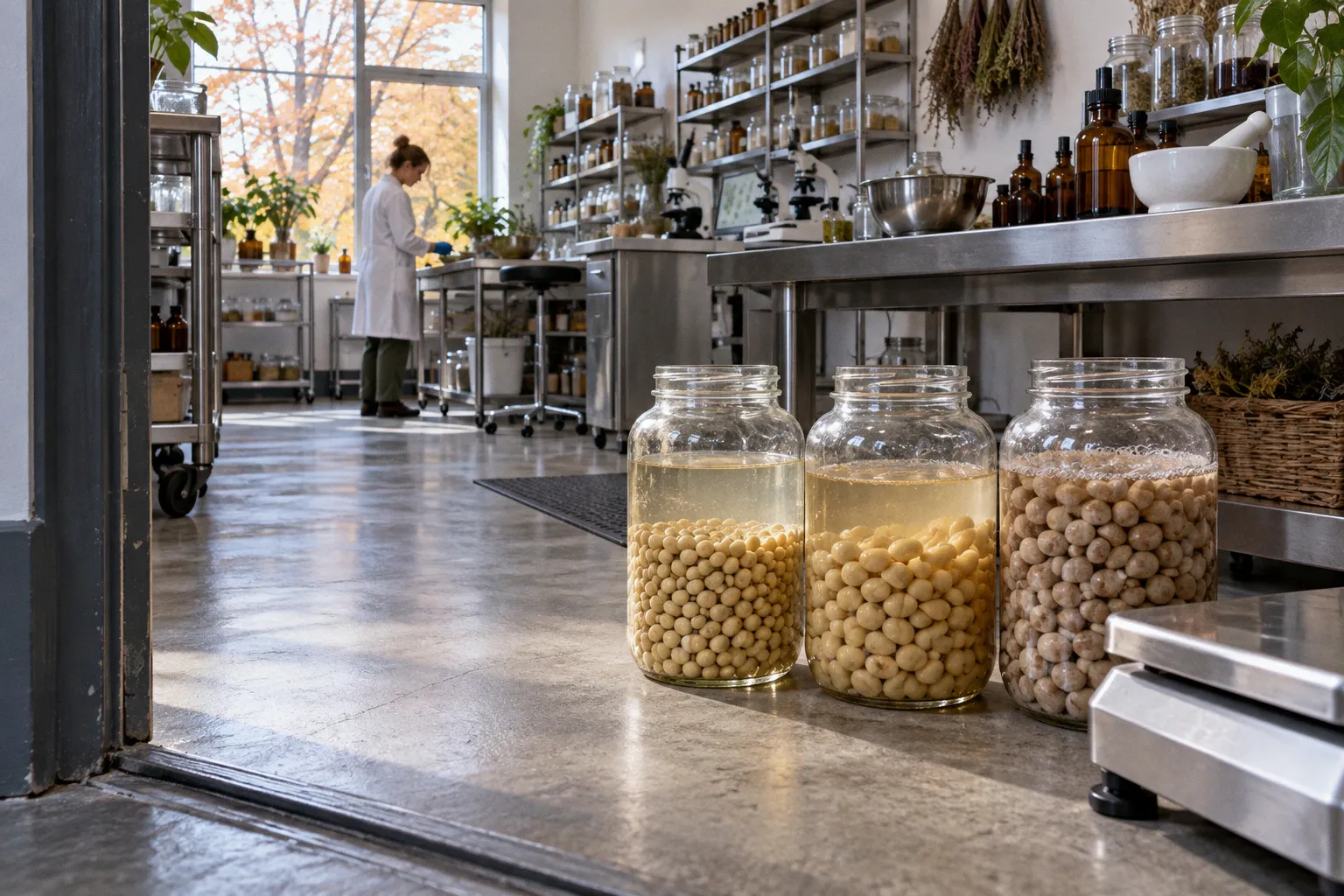
Raw dry beans contain approximately 0.6% to 2.4% phytic acid by dry weight, while lentils generally fall within a lower range of about 0.3% to 1.5%.
That does not make legumes nutritionally defective. It means that preparation changes the nutritional outcome. Soaking, germination, fermentation, alkaline treatment, and cooking can all alter the amount of phytate that remains in the finished food. The useful question is not whether phytic acid should be eliminated, but how much reduction a particular preparation method can reasonably achieve and what it costs in time, flavor, minerals, and kitchen complexity.
For people who rely heavily on legumes as a source of protein, iron, zinc, calcium, and magnesium, soaking legumes for mineral absorption is more than a traditional habit. It is a practical way to influence nutrient bioavailability. The effect is real, but it is not perfectly predictable: the legume species, cultivar, seed structure, water chemistry, temperature, pH, cooking method, and final meal all matter.
The Mineral-Binding Mechanism of Phytic Acid
Phytic acid is built around an inositol ring with six phosphate groups. At the pH conditions found in the digestive tract, those phosphate groups carry a strong negative charge. This allows phytic acid to bind positively charged minerals, especially divalent cations such as iron, zinc, calcium, and magnesium.
The resulting complexes can be difficult for the intestinal epithelium to absorb. Zinc and iron are particularly important in this context because their absorption is already influenced by several dietary factors. Calcium and magnesium can also be affected, although the practical significance depends on the rest of the diet and the amount of each mineral consumed.
This is why total mineral content can overstate the nutritional contribution of a food. A serving of legumes may contain iron on paper, but the amount absorbed will depend on the phytate content, the degree of phytate degradation, the presence of absorption-enhancing foods, and the individual’s overall nutritional status.
Several variables influence the final result:
- The legume itself. Soybeans, faba beans, common beans, chickpeas, and lentils do not begin with identical phytate levels.
- The cultivar and growing conditions. Different varieties can have different seed composition and mineral-binding behavior.
- The preparation method. Soaking alone usually produces a smaller reduction than soaking followed by boiling, germination, fermentation, or alkaline treatment.
- The cooking water. Discarding water can remove soluble phytate, but it may also remove minerals and other water-soluble compounds.
- The meal around the legume. Vitamin C can support non-heme iron absorption, while other meal components can either improve or reduce mineral uptake.
Phytic acid is not simply a toxin that needs to be removed. It has antioxidant properties and may influence glycemic and metabolic processes. The nutritional issue is one of proportion and context. A varied diet with adequate mineral intake may tolerate a moderate amount of phytate without difficulty. A diet built heavily around poorly prepared legumes, grains, and seeds presents a different situation, particularly when mineral intake is marginal to begin with.
Phytic acid is best treated as a preparation variable: it can reduce mineral absorption, but it is not automatically harmful and does not need to be eliminated from every meal.
The term “antinutrient” is therefore useful only if it is used carefully. Phytate can interfere with mineral availability under some conditions, but its effect is not identical in every person or every meal. A soaking protocol can improve the balance without turning the food into something chemically stripped or nutritionally empty.
Endogenous Phytase: The Enzyme Behind Phytate Degradation
Legumes contain their own phytase, the enzyme responsible for breaking phytic acid down into lower inositol phosphates. These smaller compounds generally have weaker mineral-binding activity than intact phytic acid. The process is known as phytate hydrolysis, and it is the main reason that time, water, temperature, and acidity matter during preparation.
Phytase is not equally active under all kitchen conditions. Plant phytase is reported to work most efficiently in an acidic environment, with a commonly cited active temperature range of approximately 45°C to 55°C and a pH range around 4.5 to 5.6. These values should be understood as operating ranges, not as a guarantee that every legume will respond identically. Enzyme activity depends on the species, the condition of the seed, the amount of water available, and the way the experiment is conducted.
At room temperature, the process is slower but still useful. Water gradually penetrates the seed, the legume swells, and endogenous enzymes become active. The longer the seed remains hydrated, the more opportunity phytase has to act. However, time does not operate independently of temperature and pH. A long soak in conditions that suppress phytase may not match a shorter soak in a more favorable environment.
Temperature also creates a practical tension. Warmer conditions can support faster enzymatic activity, but they can increase the risk of microbial growth and spoilage. A domestic kitchen is not a controlled laboratory incubator. Maintaining a legume mixture for many hours at a warm temperature requires attention to cleanliness, water changes, odor, surface growth, and the condition of the food.
The pH range deserves the same caution. Acidifying the soaking water may help bring conditions closer to the range associated with phytase activity, but the final pH cannot be inferred reliably from a spoonful of vinegar or citrus juice. Apple cider vinegar, lemon juice, cultured buttermilk, whey, and kefir vary in acidity. So does the water used for soaking. Hard or highly buffered water can resist a pH change that would be obvious in softer water.
If pH is central to the protocol, it should be measured with suitable pH strips or a calibrated pH meter. The ingredient amount is only a starting point. It is not a substitute for measurement.
Evidence-Based Soaking Durations for Maximum Bioavailability
There is no single soaking time that applies equally to every legume. In practical terms, an overnight soak is a useful starting point, while longer hydration can provide more time for phytate leaching and enzymatic activity. Published results show meaningful variation even when the nominal soaking duration appears similar.
The following examples illustrate the range rather than establish a universal schedule:
| Legume or preparation | Soaking duration | Reported conditions | Reported phytate reduction |
|---|---|---|---|
| Food-type soybeans | 12 hours | Room-temperature water | Approximately 23–30% |
| Faba beans | 24 hours | Room-temperature water | Approximately 26.9–32.5% |
| Mixed legumes with sodium bicarbonate | 12-hour soak followed by boiling | Alkaline soaking solution, then cooking | Up to approximately 78.05% |
These results should not be read as a promise for a particular batch of beans in a home kitchen. Laboratory studies often control variables that are difficult to reproduce domestically, including seed size, water-to-legume ratio, temperature, pH, cultivar, and analytical method.
A 12-hour soak is often a reasonable practical threshold because it fits an overnight routine and provides enough time for the seeds to hydrate thoroughly. It should not be described as a universal minimum below which nothing happens. Even shorter soaking can allow some water penetration and leaching, while the effect of a longer soak depends on whether phytase remains active and whether the water is changed.
A 24-hour soak may produce a different result from a 12-hour soak, particularly when the legumes remain fully hydrated and the conditions support phytase activity. Changing the water can remove soluble phytate, but it also changes the chemical environment and may remove some dissolved nutrients. More importantly, current evidence does not justify treating 24 hours as a complete ceiling for all ambient soaking methods. Some studies examine longer hydration, fermentation, germination, or combinations of methods, and the point at which additional time stops helping is not established uniformly across legumes.
The practical conclusion is narrower and more useful: overnight soaking is a sensible baseline; a longer soak may be appropriate when the legume requires it, but it should be evaluated alongside temperature, pH, food safety, texture, and the possibility of germination. There is no scientifically defensible reason to present one fixed duration as the final limit for every bean and every kitchen.
How to choose a starting duration
A workable approach is to match the soak to the food rather than forcing every legume into the same schedule.
- Small lentils often need less preparation time because they hydrate more quickly. Some varieties are cooked without soaking, although soaking can still alter digestibility and phytate exposure.
- Larger beans and soybeans generally benefit from a longer soak because water needs more time to reach the center of the seed.
- Older or very dry legumes may remain firm after a standard overnight soak and may need additional hydration before cooking.
- Faba beans and other dense seeds can respond differently from small lentils, so a published result for one species should not be transferred directly to another.
- Sprouting protocols deliberately extend the process beyond soaking and use the seed’s own metabolic activity to intensify phytase action.
The visual signs of adequate hydration are useful but limited. The legumes should be swollen, with fewer visibly dry or wrinkled centers. That tells you the seed has absorbed water; it does not tell you the exact amount of phytate hydrolysis that has occurred. Without laboratory analysis, the reduction can be estimated only from the method and published ranges, not observed directly in the bowl.
Optimizing the Kitchen Environment: Temperature and pH Factors
The two most important controllable variables are temperature and pH, but neither should be managed in isolation.
Temperature: activity versus food safety
The approximate 45°C to 55°C range is associated with strong phytase activity in plant systems, yet it is not automatically the safest or most convenient range for a prolonged domestic soak. Warm, wet legumes can support microbial growth, especially when left unattended for many hours.
A room-temperature soak is slower but simpler. If the kitchen is warm, the water may need to be changed and the legumes checked before cooking. A refrigerator slows microbial growth but also slows enzyme activity. A warm oven, thermos, or slow cooker can create a more active enzymatic environment, but only if the temperature is monitored rather than assumed.
A staged approach can be used cautiously: begin with room-temperature water so the seeds hydrate, then introduce a warmer phase if the equipment can maintain a stable temperature without cooking the outer layers or allowing prolonged exposure to unsafe conditions. The exact timing should not be presented as a universal formula. A container that holds 50°C in one kitchen may cool rapidly in another, while a slow cooker can run considerably warmer than expected.
For ordinary household preparation, the most robust protocol is often the least dramatic one: soak in clean water, keep the container covered, avoid prolonged exposure to uncontrolled warmth, and cook the hydrated legumes thoroughly. Optimizing an enzyme does not justify ignoring spoilage.
pH: measure rather than infer
Phytase activity is commonly associated with an acidic range around pH 4.5 to 5.6. Acidifying the soak may therefore be useful, but the final pH depends on more than the volume of an added ingredient.
The acidity of lemon juice changes from fruit to fruit. Vinegar products differ in titratable acidity. Cultured buttermilk, yogurt whey, and kefir vary with fermentation and dilution. Water alkalinity can buffer the added acid, leaving the soaking solution at a higher pH than expected. Even the legume itself can influence the final solution.
For that reason, adding one or two tablespoons of an acidic ingredient per liter of water should be treated only as a rough kitchen starting point, not as a guaranteed route to pH 4.5–5.6. If reaching that range is important, test the water after the acid has been mixed in. A pH strip with an appropriate range is usually sufficient for household experimentation; a meter offers greater precision but requires calibration and proper cleaning.
Acidification can also affect texture and flavor. Depending on the legume and the cooking method, acidic conditions may slow softening during the final cook. The soaking water should normally be discarded, and the legumes rinsed before cooking in fresh water.
What happens to minerals in the soaking water?
Discarding the water removes compounds that have moved out of the seed, including some soluble phytate. It can also remove minerals and water-soluble vitamins. The balance depends on the legume, the water volume, the duration, and whether the soaking liquid is consumed.
For a phytate-reduction protocol, replacing the soaking water before cooking is usually the clearer choice. It limits the return of soluble phytate to the food and allows the legumes to cook in fresh water. The trade-off is that some soluble nutrients are lost. This is one reason to avoid presenting soaking as a simple process of removing only undesirable compounds.
Cooking water creates a second decision. If the broth is discarded, more soluble compounds leave the meal, but some minerals leave with them. If the cooking liquid is retained and eaten, the nutritional balance may be better preserved, although the amount of phytate remaining in the final dish will depend on the preceding preparation.
Advanced Reduction Techniques: Beyond Ambient Water Soaking
When the goal is a larger reduction in phytate, soaking in plain water is only one option. More intensive methods include alkaline treatment, germination, fermentation, and combinations of soaking with boiling.
Alkaline soaking
Soaking in a sodium bicarbonate solution can produce a much greater reduction than ordinary water soaking under some study conditions. A cited protocol using 2% sodium bicarbonate followed by boiling achieved a reported reduction of up to approximately 78.05% in mixed legumes.
The mechanism is not limited to one reaction. Alkalinity can encourage phytate leaching and alter the structure of the seed, while boiling removes or deactivates enzymes and transfers soluble compounds into the cooking water. The result depends on the exact sequence and on how thoroughly the alkaline water is discarded.
This method has costs. Sodium bicarbonate can affect taste, texture, and sodium content. The soaking liquid should be discarded, and the legumes should be rinsed carefully before cooking. It is not automatically preferable for people who need to limit sodium, and it is unnecessary for every serving of beans.
Germination
Germination extends the process from hydration into active seed metabolism. After an initial soak, the legumes are drained and kept moist in a dark, ventilated environment. Over roughly 24 to 48 hours, depending on the seed and conditions, the developing sprout mobilizes stored nutrients. Phytase activity can increase during this phase.
Published reductions through germination alone have reached approximately 50% to 60% across multiple legume species, although the result varies by species and protocol. Germination may also increase vitamin C, which is relevant because vitamin C can improve the absorption of non-heme iron and partially offset the inhibitory effect of residual phytate.
The safety requirements are more demanding than for a simple soak. Rinsing, drainage, airflow, temperature, and odor all matter. Sprouts should not be kept in stagnant water, and any sign of spoilage is a reason to discard the batch. Germination is a useful phytate-reduction method, but it is not a set-and-forget process.
Fermentation
Fermentation introduces microorganisms that can produce phytase or create conditions that favor phytate degradation. Sourdough-style processes and cultured legume preparations may therefore reduce phytate beyond what is achieved by hydration alone. The exact result depends on the organisms involved, fermentation time, temperature, acidity, and whether the food is subsequently cooked.
This is one area where a named method can sound more precise than it really is. “Fermented” does not describe one standardized process. A short, cool fermentation and a warm, highly acidic fermentation may produce different outcomes. The final food also contains the products of fermentation, not simply the original legume with a measured percentage removed.
Cooking method
Cooking is essential for safety, digestibility, and texture, but it should not be treated as interchangeable with soaking. Boiling can move soluble phytate into the cooking water. Discarding that water may increase phytate removal while also discarding some soluble minerals. Pressure cooking shortens the cooking phase and can retain more of the food’s water-soluble components when the cooking liquid is consumed.
The most mineral-conscious method is often to reduce phytate before cooking, use fresh water for the final cook, and retain the finished cooking liquid when it suits the dish. This avoids assuming that every extra rinse or discarded broth is nutritionally beneficial.
A Practical Protocol Without False Precision
For a general kitchen routine, the following sequence is a reasonable starting point:
1. Sort and rinse the legumes. Remove stones, damaged seeds, and visible debris.
2. Cover them generously with clean water. Use enough water to allow the seeds to expand substantially.
3. Soak overnight as a baseline. A 12-hour soak is practical for many beans, but it is not a universal minimum or maximum.
4. Consider a longer soak for dense or very dry legumes. Check hydration, odor, and texture rather than relying on the clock alone.
5. If acidifying the water, measure the pH. Do not assume that a fixed amount of vinegar, lemon juice, buttermilk, whey, or kefir will produce a particular value. The documented phytase-associated range is approximately pH 4.5 to 5.6, but household conditions vary.
6. Discard and rinse the soaking water. This removes soluble compounds that have moved into the liquid.
7. Cook in fresh water until fully tender. Pressure cooking or a covered simmer can be used according to the legume and the recipe.
8. Keep the cooking liquid when appropriate. Retaining it may preserve some soluble minerals, while discarding it may remove additional soluble phytate.
9. Use a more intensive method selectively. Alkaline soaking, germination, or fermentation may be useful when a larger reduction is the priority, but each introduces its own food-safety and nutritional trade-offs.
For people with diagnosed mineral deficiencies, digestive disorders, restrictive diets, or unusually high legume intake, preparation is only one part of the picture. Iron, zinc, calcium, and magnesium status cannot be inferred from a soaking schedule alone. The overall diet, absorption capacity, medication use, and underlying health all matter.
The Practical Limit Is a Range, Not a Single Number
The evidence supports a measured approach to reducing antinutrients in beans. An overnight soak can produce a useful change, but its effect varies. A 24-hour soak may provide additional hydrolysis in some conditions, yet the research does not establish a universal ambient-soaking ceiling at that point. Longer soaking, water changes, controlled acidity, germination, fermentation, and alkaline treatment may continue to change the outcome, although not always in the same direction or at the same rate.
The same caution applies to pH. The approximate 4.5–5.6 range is relevant to phytase activity, but spoonfuls of an acidic ingredient do not guarantee that the soaking water reaches it. Water chemistry and ingredient acidity must be taken into account, and measurement is the only reliable way to know the result.
The useful protocol is not the one with the most aggressive numbers. It is the one that balances phytate reduction, food safety, mineral retention, digestibility, and the realities of the kitchen.
Phytic acid in legumes is therefore a manageable variable rather than a reason to avoid legumes. Plain soaking can help, but it is only one point on a continuum of phytate reduction methods. For most households, a well-hydrated overnight soak followed by thorough cooking is a sound foundation. When mineral bioavailability is a higher priority, measured acidification, germination, fermentation, or alkaline treatment can be considered with a clear understanding of their limits.
The aim is not to erase every molecule of phytate. It is to prepare legumes in a way that makes their protein, minerals, fiber, and broader nutritional value more available without replacing one problem with another.