Sulforaphane bioavailability: key factors in cruciferous vegetables
Sulforaphane bioavailability in cruciferous vegetables is controlled less by the amount of glucoraphanin listed in a food and more by whether the conversion enzyme myrosinase remains active.
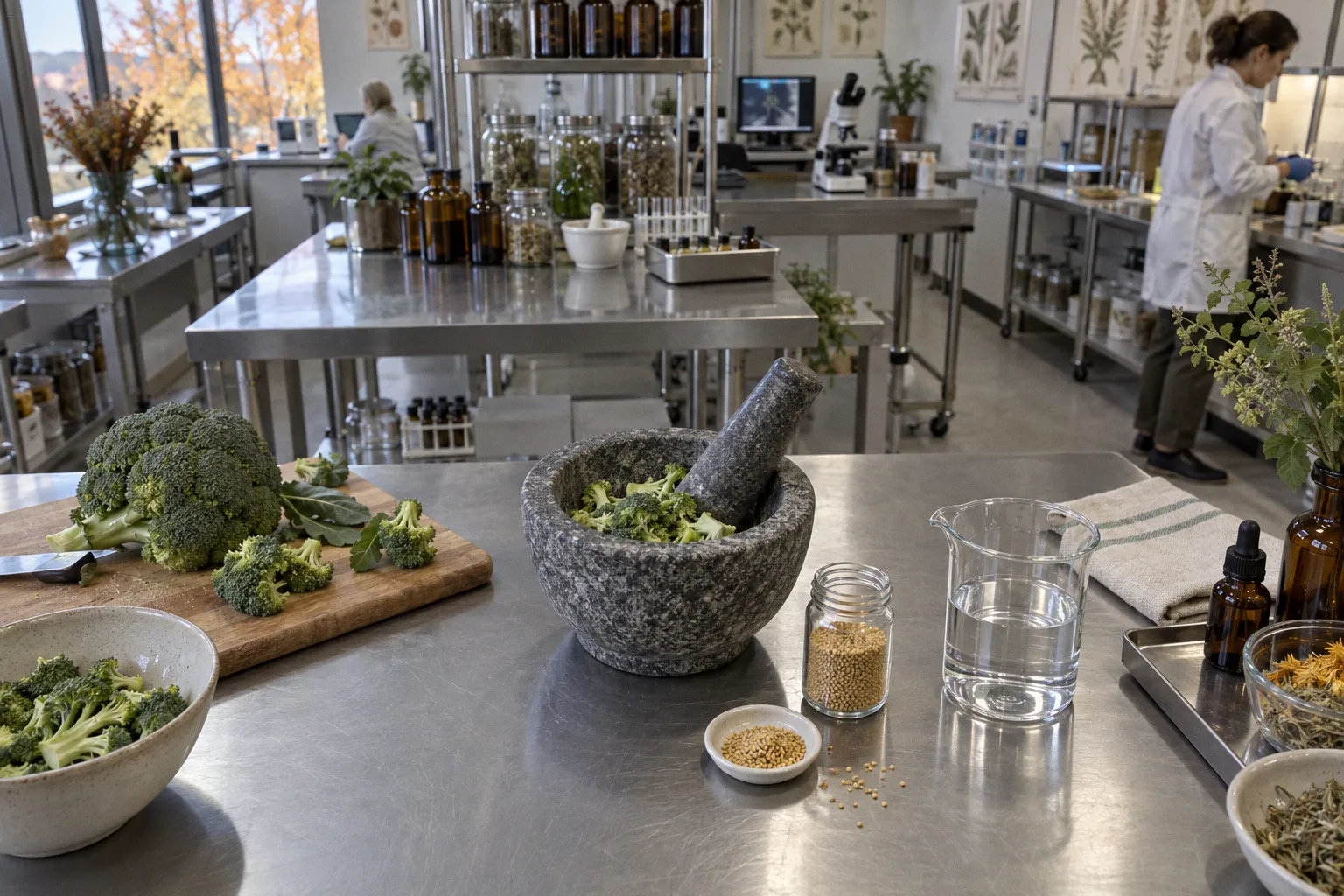
This distinction explains why two servings of broccoli can deliver markedly different amounts of sulforaphane despite containing similar precursor concentrations.
Raw broccoli provides approximately 37% sulforaphane bioavailability in the available human data. Cooked broccoli provides approximately 3.4%. The primary variable is not the destruction of glucoraphanin. Heat largely deactivates myrosinase, the enzyme required to convert glucoraphanin into sulforaphane during tissue disruption.
The practical implication is direct. Preparation determines chemistry. The same vegetable can function as a relatively efficient sulforaphane source or as a much less efficient glucoraphanin source, depending on heat exposure and whether an external source of myrosinase is added.
The enzymatic mechanism: glucoraphanin requires myrosinase
Sulforaphane does not exist in intact broccoli tissue as a fully formed compound in the same way that vitamin C or beta-carotene does. Broccoli stores glucoraphanin, a glucosinolate precursor, separately from myrosinase. The separation is a plant defense mechanism.
When broccoli cells are cut, chewed, crushed, or otherwise disrupted, glucoraphanin and myrosinase come into contact. Myrosinase then catalyzes the conversion of glucoraphanin into sulforaphane and related breakdown products.
The sequence is simple:
1. Cell walls are disrupted. Cutting and chewing expose the intracellular components.
2. Glucoraphanin contacts myrosinase. The enzyme is present in the plant but is physically separated from its substrate before tissue damage.
3. Sulforaphane is formed. The conversion occurs rapidly when active myrosinase is available.
4. Sulforaphane metabolites are absorbed and excreted. Human studies commonly assess conversion through sulforaphane metabolite measurements rather than by measuring the parent compound alone.
This mechanism creates a critical distinction between nutrient content and nutrient delivery. A food can contain glucoraphanin but produce relatively little sulforaphane if myrosinase has been deactivated before the conversion step.
The relevant question is not how much glucoraphanin broccoli contains. It is how much of that glucoraphanin is converted through active myrosinase.
Cooking does not simply eliminate glucoraphanin. The precursor remains relatively stable compared with the enzyme. The limiting factor is therefore enzymatic access. Once plant myrosinase is inactivated, conversion depends more heavily on residual enzyme activity, preparation conditions, and the capacity of the gut microbiota to metabolize glucoraphanin.
That microbial contribution is variable. It should not be treated as equivalent to active plant myrosinase. Human microbiome profiles differ, and the precise conversion rate, timing, and efficiency of gut microbial metabolism are not uniform across individuals.
Thermal sensitivity: why cooking method changes sulforaphane yield
Myrosinase is heat-sensitive. This makes cooking duration and intensity central factors affecting sulforaphane absorption.
The contrast between raw and cooked broccoli is substantial. In a randomized human crossover trial published in 2008, raw broccoli produced approximately 37% sulforaphane bioavailability, while cooked broccoli produced approximately 3.4%. This represents a major reduction in conversion efficiency after heat treatment.
The timing of absorption also changed. After raw broccoli consumption, peak plasma concentration occurred at approximately 1.6 hours. After cooked broccoli, the peak occurred at approximately 6 hours. The delayed peak is consistent with a preparation-dependent change in conversion and absorption kinetics.
The result is not merely a smaller dose arriving at the same time. Heat treatment can alter both the amount of sulforaphane generated and the rate at which its metabolites appear systemically.
Raw, lightly heated, and fully cooked broccoli
The phrase “cooked broccoli” is chemically imprecise. A brief heating period and prolonged heating are not equivalent exposures.
Light microwaving for approximately 2.0 minutes has been associated with an estimated in vivo sulforaphane yield about threefold higher than fully microwaving broccoli for approximately 5.5 minutes. The difference reflects the degree of myrosinase inactivation. Shorter heating preserves more functional enzyme activity than prolonged heating.
Steaming may also be preferable to aggressive boiling when the objective is to preserve enzymatic conversion. However, the outcome depends on temperature, duration, tissue size, water contact, and whether the vegetable reaches a level of heating sufficient to deactivate myrosinase. A broad label such as “steamed” does not define the biochemical result.
Boiling introduces an additional variable: water-soluble compounds can move into the cooking liquid. If the liquid is discarded, some glucosinolate content may be lost independently of enzyme activity. This is not the same mechanism as thermal inactivation, but it can further reduce the amount of precursor available for conversion.
Comparison of preparation methods
| Preparation method | Myrosinase status | Expected sulforaphane conversion | Practical interpretation |
|---|---|---|---|
| Raw broccoli | Largely active | Highest among the compared methods | Most direct route to rapid conversion |
| Light microwave exposure, about 2 minutes | Partially preserved | Higher than prolonged microwaving | Useful compromise between texture and enzyme preservation |
| Prolonged microwave exposure, about 5.5 minutes | Substantially reduced | Lower than brief heating | Greater softening, weaker enzymatic conversion |
| Fully cooked broccoli | Predominantly deactivated | Approximately 3.4% bioavailability in the cited human comparison | Glucoraphanin remains, but plant-driven conversion is impaired |
| Cooked broccoli with powdered mustard seed | External myrosinase supplied | Conversion can be substantially restored | Preparation strategy for heat-treated vegetables |
The exact output will vary with broccoli cultivar, maturity, storage, tissue disruption, cooking equipment, and serving size. These variables are not minor. They influence the amount of glucoraphanin present and the degree of enzymatic contact.
The 37% threshold: raw versus heat-treated vegetables
The approximately 37% figure for raw broccoli should be interpreted as a study-derived bioavailability estimate, not a universal constant. It does not mean that every raw broccoli serving produces exactly 37% conversion in every person.
The figure is useful because it demonstrates the scale of the preparation effect. Raw broccoli delivered more than ten times the measured bioavailability observed after cooked broccoli in the same research context: approximately 37% compared with 3.4%.
Several factors explain why individual outcomes will differ:
- Plant variety. Broccoli cultivars do not contain identical concentrations of glucoraphanin or myrosinase.
- Freshness and storage. Enzyme activity can change after harvest and during storage.
- Particle size. Fine chopping increases contact between glucoraphanin and myrosinase, but prolonged exposure before consumption may also change the chemical profile.
- Heat exposure. Temperature and duration determine the degree of myrosinase inactivation.
- Serving matrix. Fat, protein, fiber, and meal composition can alter gastric emptying and the timing of metabolite appearance.
- Microbiome function. Bacterial conversion of glucoraphanin is not identical across individuals.
- Measurement method. Plasma peaks, urinary metabolites, and calculated bioavailability describe related but different endpoints.
The raw-versus-cooked comparison therefore provides a mechanism-based direction rather than a guarantee. If maximum sulforaphane formation is the objective, preserving active myrosinase is the most reproducible dietary strategy supported by the available data.
This is also why supplement labels can be difficult to interpret. A product may list glucoraphanin content without demonstrating the presence, activity, or stability of myrosinase. The precursor quantity alone does not establish the amount of sulforaphane that will be produced after ingestion.
Restoring conversion with exogenous myrosinase
Cooked broccoli is not chemically inactive. It still contains glucoraphanin. The problem is that the plant’s own myrosinase has been damaged by heat.
An external enzyme source can address this limitation. Brown mustard seed contains myrosinase. In a human study, adding 1 gram of powdered mustard seed to 200 grams of cooked broccoli significantly increased sulforaphane metabolite excretion.
This is an important protocol because it separates the nutritional value of the vegetable from the enzymatic requirement. Cooking can improve texture, palatability, and tolerance while the mustard seed supplies the missing conversion enzyme.
The mechanism is straightforward:
1. Cook the broccoli according to the desired texture.
2. Allow it to cool enough that additional high heat is not applied.
3. Add approximately 1 gram of powdered brown mustard seed.
4. Mix thoroughly to distribute the exogenous myrosinase across the broccoli tissue.
5. Consume as part of the meal.
The timing of addition matters. Adding mustard powder before or during prolonged heating defeats the purpose because the external enzyme is also heat-sensitive. It should be incorporated after cooking, not treated as a cooking spice that is exposed to the same thermal load.
The 1-gram quantity is the amount used in the cited human protocol. It should not be presented as a universally optimized dose for every broccoli variety, cooking method, or serving size. The minimum effective amount across all culinary conditions remains uncertain.
Other cruciferous vegetables may also provide active myrosinase, but their enzyme concentration and glucoraphanin content vary. Radish, mustard greens, watercress, and related plants are not interchangeable with broccoli on a gram-for-gram basis. A cruciferous side dish can contribute enzymatic activity, but the resulting sulforaphane yield depends on the specific plant matrix and its preparation.
Heat-treated broccoli is not necessarily a poor choice. It becomes a lower-efficiency choice when the lost myrosinase is not replaced.
Optimizing cruciferous vegetable preparation
A practical protocol should balance enzyme preservation with food safety, texture, digestive tolerance, and routine adherence. Raw broccoli offers the strongest direct evidence for preserving myrosinase, but raw intake is not mandatory for every meal.
1. Use raw broccoli when maximum conversion is the priority
Raw florets provide active endogenous myrosinase and produce faster sulforaphane appearance than cooked broccoli in the cited comparison. Thorough chewing or mechanical chopping increases cell disruption and improves contact between glucoraphanin and the enzyme.
Raw broccoli may be less suitable for individuals who experience bloating or discomfort from large amounts of uncooked cruciferous fiber. That issue is a tolerance variable, not evidence that cooked broccoli lacks nutritional value.
2. Use brief heating rather than prolonged heating
When raw broccoli is impractical, short heating is a rational compromise. Light microwaving for approximately 2.0 minutes produced an estimated in vivo yield about three times higher than fully microwaving for approximately 5.5 minutes in the cited data.
The goal is not to keep the vegetable completely firm. The goal is to reduce the thermal exposure that deactivates myrosinase. The actual time will vary with portion size, water content, equipment power, and whether the broccoli begins chilled or at room temperature.
3. Add mustard seed after cooking
For soft, fully cooked broccoli, powdered brown mustard seed is the most direct food-based method in the available research for restoring enzymatic conversion. Approximately 1 gram added to 200 grams of cooked broccoli increased sulforaphane metabolite excretion in humans.
The powder should be added after cooking and mixed into the serving. It should not be exposed to prolonged heat. The flavor is pungent, but the quantity is small and can be incorporated into a dressing or savory sauce after the food has cooled slightly.
4. Preserve the cooking liquid when appropriate
If broccoli is boiled, some water-soluble compounds may migrate into the water. Using the cooking liquid in a soup or sauce retains more of the dissolved material than discarding it. This strategy does not restore myrosinase, but it reduces one route of nutrient loss.
It also does not convert glucoraphanin into sulforaphane by itself. An external myrosinase source is still required if the vegetable’s endogenous enzyme has been substantially deactivated.
5. Treat supplements as a separate formulation problem
A glucoraphanin supplement and a sulforaphane-producing supplement are not necessarily equivalent. The formulation must account for myrosinase activity, enzyme stability, storage, and release in the gastrointestinal tract.
Labels that report only glucoraphanin do not establish sulforaphane exposure. Labels that report sulforaphane may refer to a stabilized preparation or a calculated yield rather than the amount absorbed by a specific user. Efficacy depends on formulation, not only on the headline compound.
A protocol for consistent dietary use
For individuals using cruciferous vegetables as part of a food-as-medicine strategy, consistency is more relevant than occasional high-dose intake. A reasonable weekly protocol can use different preparation methods rather than forcing every serving to be raw.
One serving may consist of raw broccoli or finely chopped broccoli added to a meal. Another may use briefly heated broccoli. A fully cooked portion can be paired with powdered brown mustard seed after cooking. This approach maintains dietary variety while preserving the central biochemical objective: active myrosinase exposure.
The protocol should also distinguish between sulforaphane formation and broader cruciferous vegetable nutrition. Cooking changes enzyme activity, but it does not erase the vegetable’s fiber, minerals, carotenoids, protein, or entire phytochemical profile. A reduction in sulforaphane bioavailability is not a reason to classify cooked broccoli as nutritionally empty.
The strongest claim supported by the evidence is narrower and more useful: raw or minimally heated broccoli generally offers more efficient plant-mediated sulforaphane conversion than fully cooked broccoli, and exogenous myrosinase can improve conversion from heat-treated tissue.
No preparation method can remove all biological variability. The microbiome remains a variable. So do plant chemistry, portion size, storage, and cooking conditions. The objective is not to engineer an exact plasma concentration in a home kitchen. It is to avoid a preventable loss of enzymatic function.
Practical protocols
- For maximum endogenous conversion: consume broccoli raw, with thorough chewing or chopping to disrupt plant tissue.
- For a cooked preparation: use brief heating rather than prolonged microwaving or extended boiling.
- For fully cooked broccoli: add approximately 1 gram of powdered brown mustard seed to 200 grams of broccoli after cooking.
- For meal preparation: avoid heating the mustard powder for a prolonged period because myrosinase is also heat-sensitive.
- For boiled vegetables: retain the cooking liquid in soups or sauces when appropriate.
- For supplement evaluation: distinguish glucoraphanin content from demonstrated myrosinase activity or sulforaphane yield.
- For interpretation of research figures: treat 37% versus 3.4% as study-derived comparative values, not fixed results for every person or every broccoli serving.
- For long-term use: prioritize a repeatable preparation protocol that preserves enzyme activity without compromising tolerance or dietary adherence.
Sulforaphane bioavailability in cruciferous vegetables is primarily an enzymatic problem. Glucoraphanin is the precursor. Myrosinase is the conversion variable. Heat separates the two by deactivating the enzyme while leaving much of the precursor intact. Raw broccoli, brief heating, and post-cooking mustard seed each address that mechanism in different ways.
The most efficient strategy is therefore precise rather than ideological: preserve myrosinase when possible, replace it when necessary, and do not confuse the presence of glucoraphanin with the delivery of sulforaphane.